
House rural development committee backs Apache Junction funding, broadband and a transfer of disputed Pinal road funds to ADOT
Get AI-powered insights, summaries, and transcripts
Sign Up Free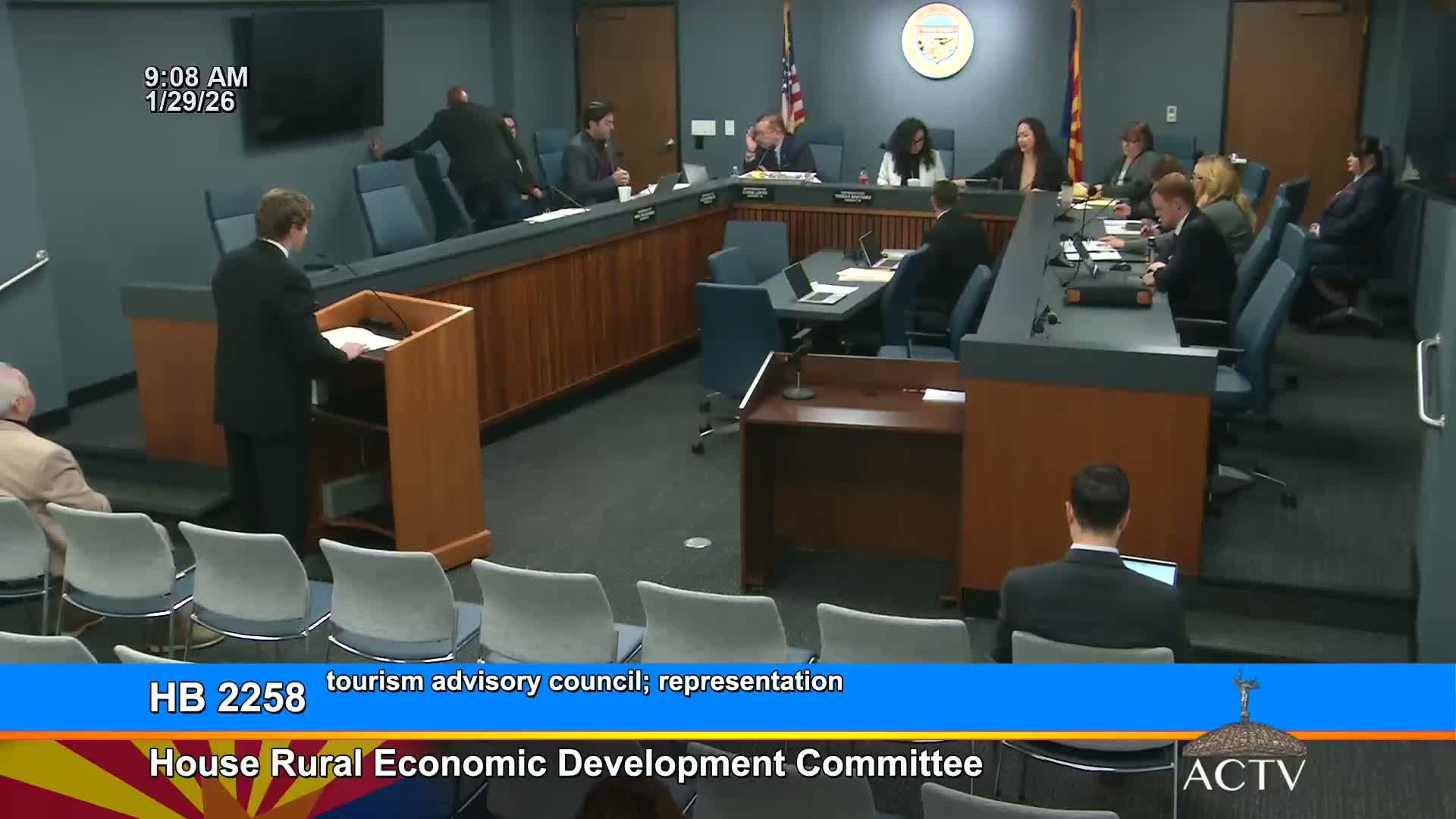
Summary
The House Committee on Rural Economic Development gave due-pass recommendations to multiple appropriations for Apache Junction (housing, broadband, business hub), added La Paz County to the Tourism Advisory Council, and passed an emergency measure directing leftover Pinal County transportation excise-tax funds to ADOT.
The House Committee on Rural Economic Development on April 10 moved several appropriations and a representation change for the Tourism Advisory Council, directing funds for housing, broadband and rural business investment in Apache Junction and approving an emergency transfer of disputed Pinal County transportation-tax proceeds to the Arizona Department of Transportation.
Chairman Martinez opened the meeting by setting a firm end time and asking members to keep remarks brief. The committee first approved committee rules, then unanimously advanced House Bill 2258, which adds La Paz County to Area 4 for representation on the Tourism Advisory Council. "They've left out La Paz County. We are adding it to the list of counties that are represented," the bill sponsor said, and the committee approved the bill 7–0.
The committee then considered a package of appropriations for Apache Junction. House Bill 2065 would appropriate $9.5 million from the state general fund in fiscal year 2027 to the state treasurer for housing infrastructure, housing rehabilitation and blight abatement in Apache Junction. The sponsor said the funding responds to statewide housing shortages that are spilling into rural-adjacent communities near Maricopa County and asked the committee to support the request. Representative Peshta Kai asked how much of the $9.5 million would go "just to housing," a question the sponsor said could be addressed later; the committee returned HB 2065 with a due-pass recommendation by a 6–1 vote.
House Bill 2066 would appropriate $8 million for expansion of broadband and fiber-optic networks in Apache Junction. Sponsor Representative Bachman emphasized gaps in rural broadband coverage, particularly on the Navajo Nation, and said she was willing to work with members and to pursue federal matching funds (including BEAD) where available. Members pressed whether federal BEAD funds could be used as a match; the sponsor said she would pursue matching funds. The committee returned HB 2066 with a due-pass recommendation, 6–1.
Chairman Martinez then sponsored House Bill 2106, an emergency measure addressing undistributed or nonrefunded revenues collected before April 10, 2026, from a county transportation excise tax. Martinez recounted litigation by the Goldwater Institute that led to a multi-year refund process; he said roughly $80 million had been collected and refunded in part, and that about $50 million remained in an escrow account. The bill would allow the Arizona Department of Transportation to use those escrowed funds on Pinal County roads "so ADOT use it for what the voters intended, which are roads in Pinal County," Martinez said. The committee voted 7–0 to give HB 2106 a due-pass recommendation.
The committee also considered House Bill 2071, a $15.5 million appropriation for a rural business and workforce hub, rural infrastructure revitalization, and development of a rural health and community services facility in Apache Junction. Sponsor Representative Blackman said recent redistricting and local needs motivated the request, and he welcomed amendments to spread benefits across other rural districts or add accountability language for funds used on tribal lands. Members raised the difficulty of development on federal/trust lands such as the Navajo Nation and asked for state accountability language; the sponsor said he would work on amendment language. The committee returned HB 2071 with a due-pass recommendation by a 6–1 vote.
What the committee did and what happens next
- HB 2258 (adds La Paz County to Tourism Advisory Council representation): passed with a due-pass recommendation, 7–0. - HB 2065 (Apache Junction housing infrastructure, $9,500,000 FY2027): returned with due-pass recommendation, 6–1. A member asked how much of the appropriation is earmarked specifically for housing; the sponsor said details would be worked out in appropriations and budget negotiations. - HB 2066 (Apache Junction broadband expansion, $8,000,000 FY2027): returned with due-pass recommendation, 6–1. Sponsor committed to pursue federal BEAD matching funds. - HB 2106 (emergency allocation of undistributed/nonrefunded county transportation excise tax revenues to ADOT for county projects): returned with due-pass recommendation, 7–0. Sponsor said roughly $50 million remained in escrow after refunds tied to litigation and the bill would allow ADOT to use those funds for Pinal County roads. - HB 2071 (rural business/workforce hub and rural health facility support, $15,500,000 FY2027): returned with due-pass recommendation, 6–1. Sponsor invited amendments and accountability language for funds directed to tribal areas.
Committee members and staff said there were no in-room public testimonies signed for the bills on the agenda and that written statements would be circulated when submitted. Several members urged broader or more targeted approaches — including ensuring state funds complement federal programs and adding transparency and accountability language for state dollars used on tribal lands.
The committee adjourned after giving due-pass recommendations to the bills it could complete in the allotted time; remaining items (if any) will be added to the next agenda.