House committee advances bill to require age verification and cover AI-generated intimate images
Loading...
Summary
The House AI & Innovation Committee returned House Bill 21-33 with a due-pass recommendation after adopting an amendment that excludes ISPs and cloud/search providers; the bill would require commercial distributors of explicit material to use reasonable age verification and treats synthetic (AI-altered) nonconsensual imagery as covered content, with civil penalties.
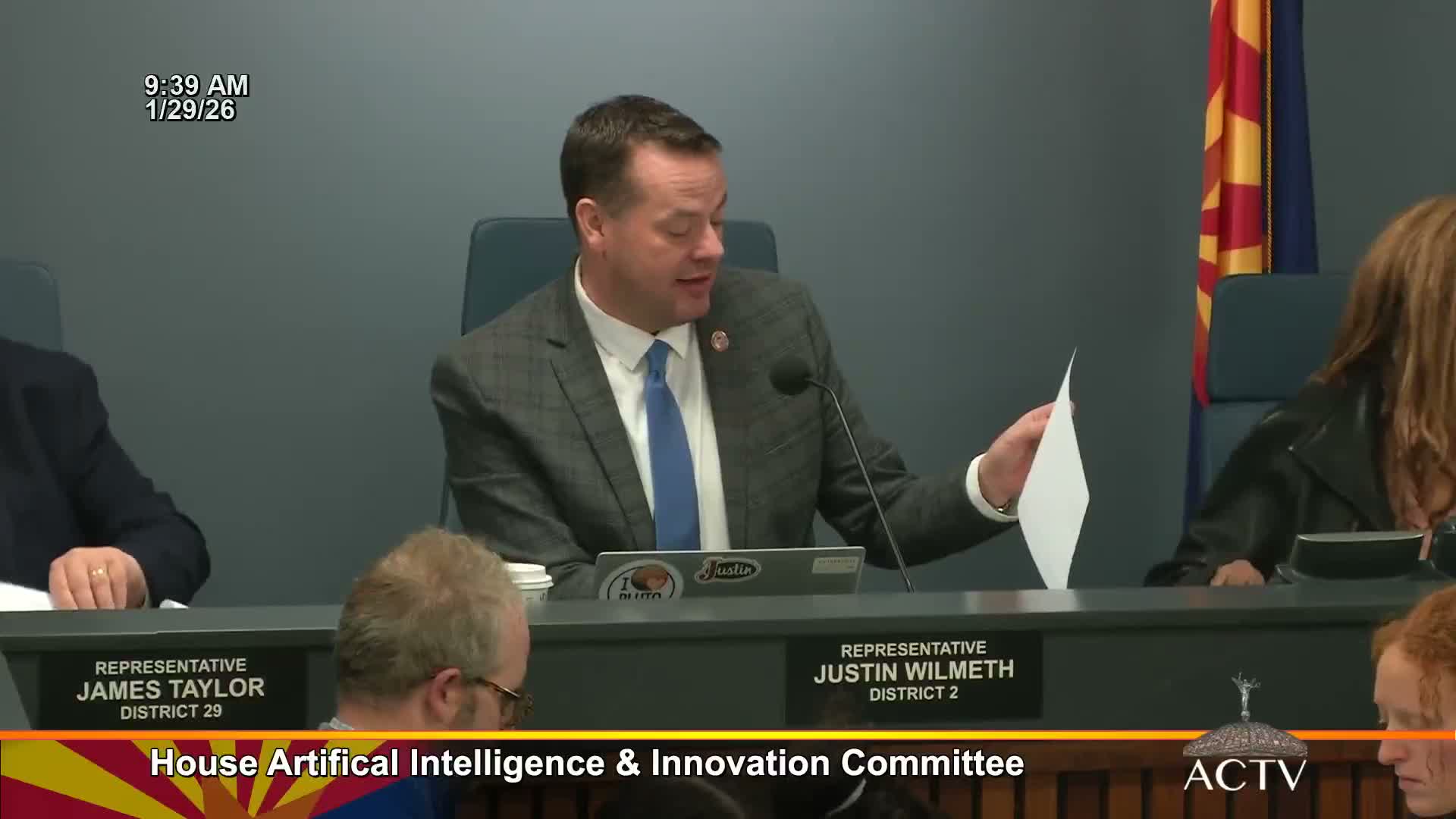
The Arizona House AI & Innovation Committee on Jan. 26 advanced House Bill 21-33, a measure that would require commercial entities distributing explicit material on the internet to use reasonable age verification and would explicitly include synthetic or AI-altered images in the covered definition.
Representative Kuppe, the bill sponsor, told the committee the measure is intended to protect people depicted in explicit material and to extend consent and age-verification standards to online content, including synthetic depictions. He said the bill is aimed at preventing exploitation and nonconsensual publication: "We are not okay with exposing people who did not consent," Kuppe said.
Staff described a five-page amendment (dated Jan. 26, 01/26/26 11:07AM) that narrows who is responsible under the bill by excluding internet service providers, search engines, cloud service providers, and their affiliates when those entities do not create or directly host the material. The amendment was adopted by the committee before the floor vote.
Sponsor testimony said the bill's penalties "mostly mirror" other states and previously enacted Arizona measures and described a penalty framework that, in the sponsor's explanation, can include fines assessed per day of continued violation. The sponsor gave an example of a $10,000-per-day penalty level, while a committee member contrasted that with federal legislative language discussed in the U.S. Senate earlier this month.
No public witnesses appeared to testify; one person had signed in but did not attend. After discussion and several committee members saying they would reserve the right to change their vote pending stakeholder conversations, the committee voted to return House Bill 21-33 as amended with a due-pass recommendation by a recorded tally of 5 ayes, 0 nays, 2 present and 0 absent.
The bill will move forward in the House process for further consideration and potential floor action.