
APS tells House committee it filed rate changes to make data centers "pay for growth"
Get AI-powered insights, summaries, and transcripts
Subscribe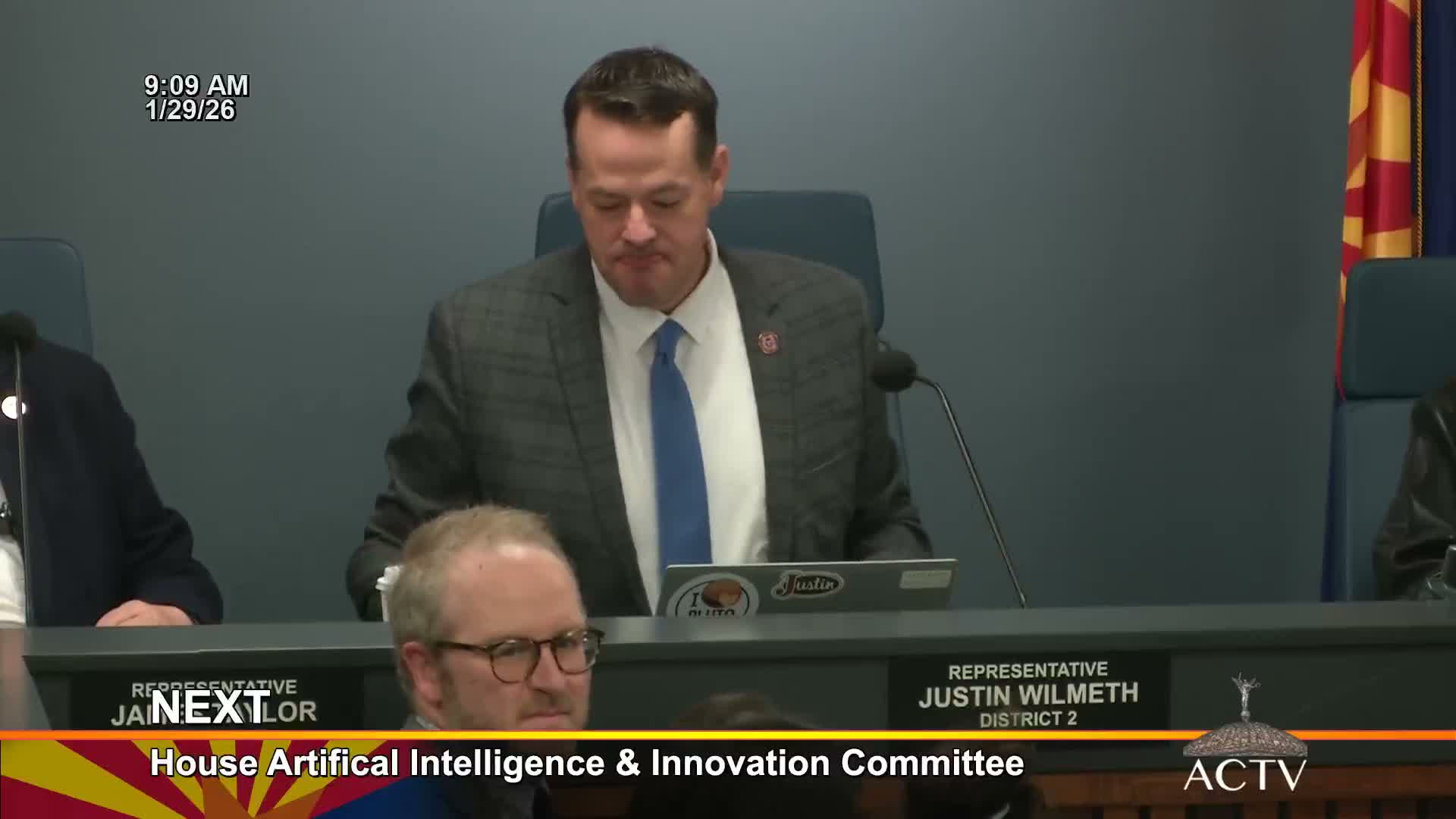
Summary
APS told the Arizona House AI & Innovation Committee it has filed a rate case and is pursuing contracts to ensure data-center customers pay new infrastructure costs, proposing a roughly 45% increase to the high-load data-center rate and tools such as minimum bills and queuing to avoid shifting costs to residential customers.
Arizona Public Service told a House committee on Jan. 26 that it has filed a rate case and is pursuing contractual options intended to ensure data-center customers cover the utility investments needed to serve rapid industry growth.
Jessica Hobick, vice president of rates and regulation at APS, told the House AI and Innovation Committee that the utility's approach is guided by three principles: preserve reliability for existing customers, protect affordability for residential and small-business customers, and preserve capacity for non-data-center growth. "Growth should pay for growth," Hobick said during an appearance alongside Matt Liguori, APS's director of public affairs.
The presentation laid out APS's view of the scale of recent growth: the utility recorded a 2025 summer peak of about 8.7 gigawatts and said it expects peak demand in its service territory could grow toward 12 GW by 2035 as data-center load increases. Hobick described a 19 GW queue of proposed data-center capacity and said typical large data centers average roughly 400 megawatts; some proposed campuses seek multiple facilities of 1,200 to 2,000 MW each.
To address that growth, APS described two primary pathways. The first is a modernization of its 2017 high-load-factor data-center tariff through a rate case APS filed in June; the company said the filing includes an incremental 45% increase to the data-center rate schedule to better allocate costs to those customers. The second is negotiated, bespoke contractual agreements with individual data-center customers that would include significant upfront financial contributions and long-term obligations so costs do not shift to other customers.
Hobick detailed several tools APS would use to limit cross-subsidies: minimum-bill thresholds so customers pay for capacity procured on their behalf even if they ramp more slowly than expected; a queuing process to allocate limited capacity fairly; and an annual formulaic true-up to update rates as APS makes investments year to year. She said APS developed the approach after reviewing practices in other regions and utilities, including PJM and AEP Ohio, which have taken steps to treat data centers differently for cost allocation.
Committee members asked whether the proposed increase would chill new investment in Arizona. Hobick said APS has discussed the proposal with large hyperscalers and acknowledged that some projects could site elsewhere, but she emphasized the company's priority is to avoid compromising reliability or shifting costs to residential customers. "If some opt to locate elsewhere, that's a possibility," she said, adding that APS's core premise is protecting existing customers.
Members also pressed APS on resource options and on whether small modular reactors (SMRs) or full-scale nuclear are feasible additions to serve load; Hobick said APS is evaluating both and has applied for a Department of Energy grant to explore additional nuclear development. On behind-the-meter generation, Hobick told members it is not part of the current rate-case proposal and that fully self-supplied data centers would likely require unique contractual solutions.
APS told the committee that its last implemented increase took effect in March 2024 and that the current case will proceed through hearings this summer with an order expected later in the year. Hobick offered to provide follow-up technical detail to the committee if members wanted deeper information.
The committee did not take formal action on APS's proposals during the meeting; APS representatives left the committee with an open invitation to return with additional slides and follow-up.