Auditors find enforcement gaps in Arizona Board of Pharmacy’s prescription monitoring program; committee votes to continue board
Loading...
Summary
An Auditor General review found the Arizona State Board of Pharmacy met licensing deadlines but did not adequately enforce Controlled Substances Prescription Monitoring Program requirements and left many complaints unresolved; the joint Health and Human Services Committee voted to continue the board for six years with recommended statutory changes.
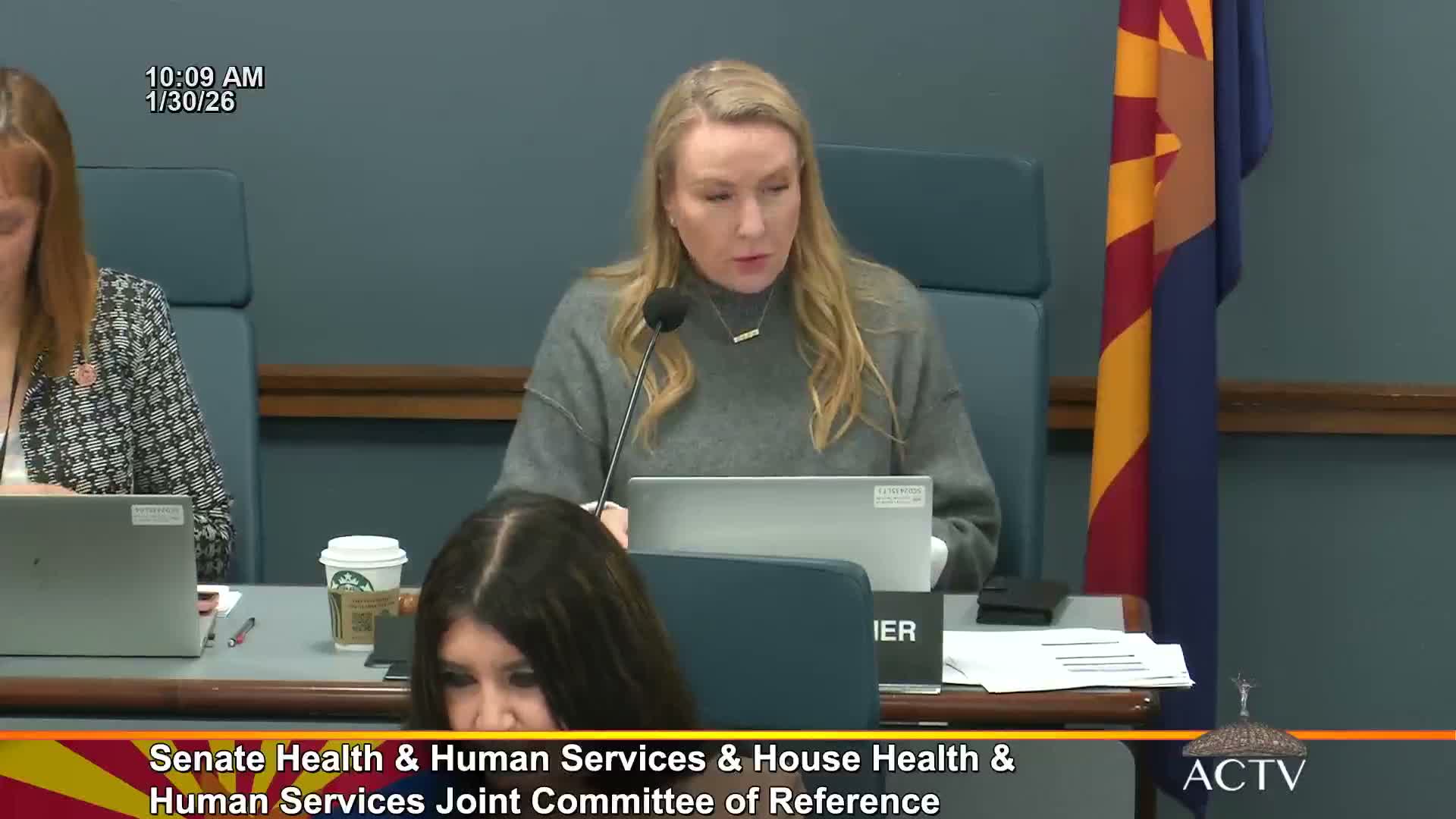
Katie Rosvasky of the Arizona Auditor General’s office told the joint Health and Human Services Committee that the Arizona State Board of Pharmacy generally met licensing timeframes but fell short in enforcement of the Controlled Substances Prescription Monitoring Program (CSPMP) and in timely investigating complaints.
Rosvasky said the audit found the board had not verified whether pharmacists reviewed patient prescription data in the CSPMP before dispensing controlled substances, and that pharmacies’ required 24‑hour dispensing reports were often not identified as missing until the board waited 10 days. The audit also reported that 7,465 prescribers — described in the report as about 17% of licensed prescribers as of June 2024 — were not registered with the CSPMP, and that a sample of high‑volume prescribers issued more than 15,000 prescriptions without checking the database.
The Auditor General’s contractor made recommendations both to the board and to the legislature to strengthen prescriber registration and enforcement. Among legislative options the contractor suggested was requiring a single controlled‑substance registration and giving enforcement authority to a centralized licensing entity, or clarifying and setting time frames for other licensing boards to pursue enforcement when their licensees violate CSPMP requirements.
Cam Gotten, introduced at the hearing as executive director of the Arizona Board of Pharmacy, said the board has implemented 11 audit recommendations and is working on the remainder. Gotten described a failed multi‑year effort to develop a new CSPMP database vendor (a contract the board terminated and for which the board recovered about 75% of fees) and said the board is again reviewing vendors. He told members that some recommendations will require legislative action and that a working group would help the board determine how to use CSPMP data for enforcement.
Committee members questioned whether the board could uniquely identify pharmacists in the CSPMP and raised the timing and resources needed to examine potential noncompliance. The board said investigators and database limitations constrain its ability to identify and pursue all noncompliance cases.
Public member Frank Thorwald told the committee he finds the board efficient for its size and budget but suggested process and registration improvements for manufacturers and products to aid enforcement.
After discussion, a committee member moved that the panel recommend continuing the Arizona State Board of Pharmacy for six years, through 07/01/2032, and that statutory changes be made to help the board perform its duties. The committee approved the motion by voice and roll‑call; the chair announced the recommendation passed by a recorded vote of 13 ayes, 0 noes, and 6 not voting.
The Auditor General’s office contracted an independent firm to audit and will follow up in the spring to assess implementation of the recommendations.