Get Full Government Meeting Transcripts, Videos, & Alerts Forever!
Get email alerts on the School Programs topic
No spam. Unsubscribe anytime.
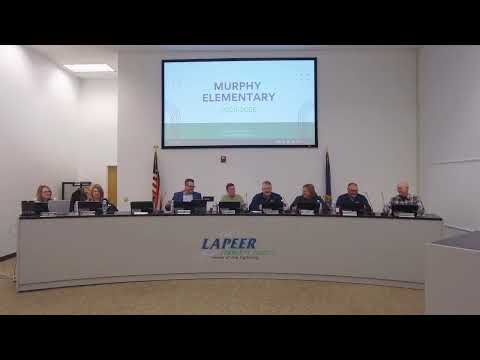
Merkley and Murphy staff tell Lapeer board Tier 1 focus, Positivity Project boosted attendance and behavior supports
Summary
Presenters from Merkley Elementary and Murphy described a district Tier 1 (MTSS) approach and adoption of the Positivity Project (P2). School staff reported a drop in total student absence days (1,625 to 1,336) and said P2 provides tiered social-emotional lessons and family resources.
Stacy Weber, principal of Merkley Elementary, told the Lapeer Community School Board that Merkley and Murphy staff have emphasized a whole-child Tier 1 approach this year, aligning universal instruction, behavior expectations and attendance work through a multi-tiered system of supports (MTSS).
"Tier 1 is not a program. It's the quality of our universal instruction and culture," Weber said, describing schoolwide professional-development work and posters used to establish consistent practices. She said the school's Student Assessment Team (SANS) cycles through identifying, analyzing, implementing and evaluating interventions for academics, behavior and attendance.
Rhiannon De Stefano, identified in the transcript as a mental health specialist at Murphy, described the Positivity Project (P2) the schools adopted to provide tiered social and emotional lessons for all students and families. "P2 helps foster stronger connection in a safer, more supportive learning environment," De Stefano said, and noted the program includes parent resources and tier 2 and tier 3 follow-up supports for students who need them.
A first-grade teacher described classroom-level differentiation in math: students take pretests and are moved between first- and second-grade units as needed; some lower-performing students work on aligned kindergarten materials in a designated work area. That shared planning, presenters said, lets teachers move students to the level they need without changing core standards.
Presenters highlighted the school's attendance challenge: classes that achieve 95% attendance earn monthly rewards. They reported a districtwide reduction in total days absent from 1,625 last year to 1,336 this year, a gain they attributed to staff focus and the incentive structure. Board members asked how the program is funded; presenters said individual buildings self-fund through fundraising (for example, a "5 birds" fundraiser reportedly covers nearly half of a building's P2 costs) and that Murphy purchased a half-year package and will fundraise for continuation.
The presentation included examples of data and a student explanation of how team-focused incentives helped classmates attend school. Presenters said kindergarten and third grade still lag target attendance and will be priorities for further work.
The meeting record shows the presentation was for board information; no new district-wide funding decision or policy vote on P2 or attendance incentives was recorded in the provided transcript. The board's questions and the presenters' answers focused on program design, local fundraising and early attendance and behavior indicators.