Get Full Government Meeting Transcripts, Videos, & Alerts Forever!
Get email alerts on the Bay Delta Plan Overview topic
No spam. Unsubscribe anytime.
State Water Board begins three‑day hearing on Bay‑Delta Plan update as agencies and advocates clash over voluntary agreements
Summary
On Jan. 28 the State Water Resources Control Board opened a three‑day hearing on the December 2025 revised draft Sacramento‑Delta update and new Chapter 13. Staff outlined two implementation paths — a regulatory percent‑of‑unimpaired‑flow approach and a Healthy Rivers & Landscapes (voluntary agreement) pathway — setting up intense technical and political debate across agency, tribal, environmental and water‑user groups.
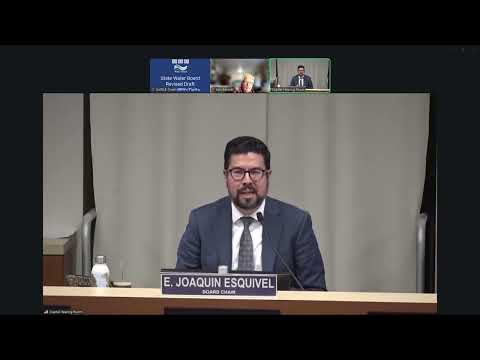
The State Water Resources Control Board convened a three‑day public hearing on Jan. 28, 2026, to receive oral input on the December 12, 2025, revised draft updates to the Bay‑Delta Plan and a newly released Chapter 13 of the draft staff report. Chair Joaquin Esquivel opened the session and reminded participants that no formal board action would occur during the hearing days and that staff will prepare written responses to oral and written comments before any adoption decision.
The revised draft presents two distinct implementation pathways for new water‑quality objectives intended to protect fish and wildlife: a regulatory pathway that would set tributary inflow requirements as a percent of unimpaired flow (a 55% starting point with an adaptive range of 45%–65% and specific ‘‘water supply adjustments’’) and a voluntary‑agreement pathway, known as Healthy Rivers & Landscapes (HRL), that combines flow, habitat, science and governance commitments for identified water rights on an initial eight‑year term.
Board staff described the mechanics and legal framing. Assistant deputy director Diane Riddle summarized the hearing schedule and scope, and staff modeled the two pathways with the Sacramento Water Allocation Model (SACWAM) in Chapter 13. Staff emphasized that the 55% starting point in the December draft is presented with water‑supply adjustments that reduce the percent required in drier conditions and that the VA pathway would be applied only to water rights listed in Appendix B‑1 and subject to annual and periodic review.
Agency leaders defended the update and described real‑world testing and adaptive management. Secretary Wade Crowfoot told the board the HRL approach is ‘‘science based and outcomes focused’’ and urged accountability and monitoring to ensure the program works. Department of Water Resources Director Carla Namath described the department’s use of an incidental‑take permit amendment to carry out adaptive operations during a recent ‘‘first‑flush’’ storm and said DWR’s assessment indicated roughly ‘‘about 15,000 acre‑feet of additional exports in this timeframe,’’ and an estimated 1% change in delta outflow for that event.
Supporters of HRL — including many regional water agencies and early‑implementation project teams — told the board they have delivered dozens of habitat projects, some already providing measurable ecological benefits. Panelists highlighted projects such as the Lower Elkhorn Basin levee setback (floodplain habitat showing high zooplankton biomass) and small‑scale Mokelumne River floodplain projects that panelists said juvenile Chinook are already using.
Opponents — fishing organizations, some conservation scientists and environmental‑justice groups — argued the VA pathway provides too little protected water, has weak or uncertain enforcement, and may not deliver measurable population‑level benefits. Multiple commenters pointed to model comparisons in the draft report and in the recirculated SED showing the VA yields a small average water‑supply cost (about 1% modeled across years) while regulatory approaches without WSAs impose larger supply impacts but produce substantially larger flow improvements in many model runs. Several scientists warned the eight‑year ‘‘experiment’’ design may not produce a detectable biological signal because of natural variability and lack of a clear burden‑of‑proof tied to outcomes at adoption.
Tribes, Delta community representatives, and public‑health advocates urged stronger numeric protections for water quality and measures to address harmful algal blooms and salinity intrusion. Staff and board members acknowledged those concerns and said Chapter 13 and the plan include monitoring and special studies for HABs, and that implementation rules remain a priority for additional work.
No votes were taken. The board is accepting written comments through Feb. 2, 2026, and staff said it will use the hearing record and written submissions to prepare responses and a final draft for a future publicly noticed board meeting on adoption.
What happens next: Staff will compile written and oral comments, refine analyses and the implementation details — particularly the accounting, monitoring and the regulatory backstop — and return to the board later for a decision. As Chair Esquivel told the room, ‘‘We’re intently listening to your feedback and really appreciate everyone’s time and attention here.’’