Committee approves Banking Departments housekeeping bill adding elder- fraud holds, Bitcoin kiosk rules and litigation-finance oversight
Loading...
Summary
A legislative committee voted to advance LC620310S, the Georgia Department of Banking and Finances annual housekeeping substitute, which would let trained financial-institution staff place discretionary holds to block suspected elder financial exploitation, require registration and consumer disclosures for virtual-currency kiosks, and tighten annual registration and screening of litigation financiers.
A legislative committee approved LC620310S, the Georgia Department of Banking and Finances annual housekeeping substitute bill, following a floor presentation and member questions. The bill would create three main changes: an optional transaction-hold tool to protect eligible adults from suspected financial exploitation, new registration and consumer-protection rules for virtual-currency kiosks (commonly called Bitcoin ATMs), and strengthened annual registration and oversight for litigation financiers.
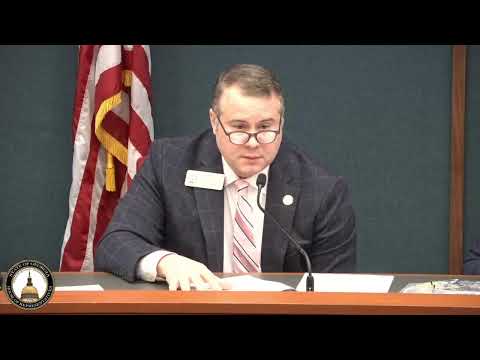
The bills author and committee presenter, Chairman Bruce Williamson, said the hold provision would let a trained financial institution temporarily pause a transaction when staff reasonably believe an eligible adult is being exploited. "This bills gonna attempt to put some guardrails around our elderly," Williamson said in committee when describing scams that use synthetic or impersonated voices to coerce victims into wiring money. Under the proposal, an institution may place a discretionary hold of up to 15 days while it investigates and may extend the hold an additional 15 days if the investigation continues to indicate likely exploitation. Institutions may contact a "trusted contact" designated by the account holder to help resolve questions.
Amy Patterson, attorney for the Georgia Department of Banking and Finance, told members the holds are discretionary and the bill does not create liability for an institution that places or fails to place a hold, stressing the policy and training components that would govern staff decisions. "The holds are discretionary on the part of the financial institution," Patterson said; she added training benchmarks would guide what constitutes a reasonable belief and how frontline staff should respond.
Members who spoke in favor said the tool could slow or stop rapidly executed scams and provide a way to involve family or caretakers. Representative Scott, who told the panel he was personally targeted in an impersonation scheme, urged careful coverage of impersonation and remote takeover scenarios. Other members urged follow-up reporting and department-facilitated training so institutions adopt the option rather than leaving it unused.
The bills second major component would introduce kiosk-specific rules for virtual-currency cash-to-crypto machines. Williamson said kiosks are currently licensed as money transmitters but lack protections specific to kiosk operations. The proposal would require annual registration of kiosk operators, require disclosures that virtual-currency transactions are irreversible and volatile, cap operator fees (the bill proposes an 18% maximum), and set aggregate daily limits for customersactivity (Williamson described a lower initial limit for new customers during a three-day period and a higher daily aggregate limit for established customers). In committee discussion Patterson said the department has limited data but believes about 20 companies operate in the space and estimated roughly 1,300 kiosks statewide based on the last publicly available information.
Williamson also said the bill would create consumer refund protections for new customers: if a new customer can show, within five days and with a law-enforcement report, that they were fraudulently induced to enter the transaction, the kiosk operator would be required to refund the full transaction amount; fees would be refundable to the extent they can be shown as part of the proven fraudulent inducement.
The bills third major change would expand oversight of litigation financiers, including moving from a one-time registration to annual registration, allowing the department to check conviction histories for owners and officers (to enforce an existing 10-year felony-conviction bar), limiting certain foreign ownership influence, and giving the department stop-work authority (cease-and-desist) over unlicensed operators.
After questions and discussion about optional versus mandatory adoption of the hold tool, training benchmarks and data collection on kiosk locations and ownership, the committee made and seconded a motion to pass LC620310S. The panel approved the bill by voice vote and adjourned. The bill now proceeds to the next legislative step (committee/house processing not specified in the transcript).