
Independent review says JCPS forecast model gives useful short-term signals but lacks multi-year precision
Get AI-powered insights, summaries, and transcripts
Subscribe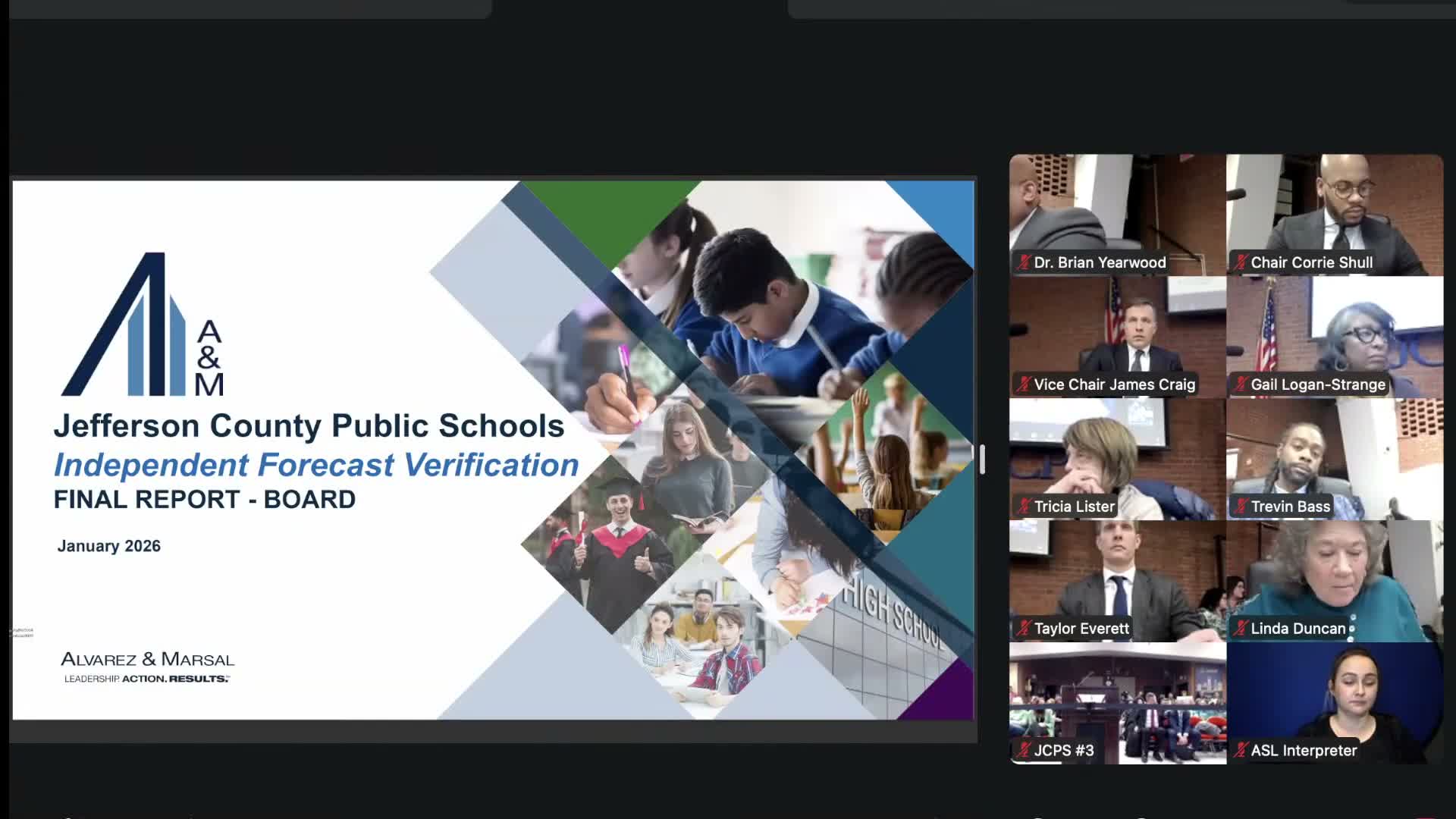
Summary
Alvarez & Marsal told the Jefferson County Board of Education the district's forecast model offers directionally accurate near-term and cash-flow information but should be rebuilt with bottoms-up assumptions and better categorization to reliably guide multi-year policy decisions.
Consultants from Alvarez & Marsal presented an independent verification of Jefferson County Public Schools' multiyear forecast model at the board's Jan. 20 meeting, telling trustees the tool gives reliable short-term cash-flow information but lacks the granularity for precise multi-year budgeting and policy-making.
Noah Wettman, a senior director with the consulting firm, said the model "provides reliable information on how the fiscal year will end" and is directionally accurate for the next budget year, but that accuracy drops for FY28 and beyond without more detailed, bottoms-up assumptions. The consultants recommended (1) including "on-behalf" payments in the model's accounting so documents reconcile more easily, (2) standardizing categorization across the forecast, budget and audited financials, and (3) developing a bottoms-up model of discrete revenue and expense drivers.
Why it matters: The consultants framed the model as a useful starting point that correctly signals the magnitude of the district's fiscal challenge but cautioned that reliance on its high-level assumptions could produce imprecise policy decisions. Alvarez & Marsal illustrated tradeoffs (property-tax growth assumptions, vacancy savings, non-personnel expenditures) that affect deficit estimates.
Key findings and numbers: The consultants showed how the forecast produced a directional deficit figure (the model aggregated to a $132 million example in presentation materials) but stressed that figure is not a precise endpoint due to omitted non-personnel spending and variable carryforward and vacancy-credit assumptions. They advised a 2-month timeline to construct a more detailed model sufficient for budgeting use.
Board reaction: Trustees asked granular questions about property-tax assumptions, vacancy savings (declining from previously estimated $65 million to $35 million in next year's forecast), and whether the model can reliably inform decisions tied to October cash-flow risks. Alvarez & Marsal said the model is "fairly reliable" for cash-flow timing but less so for long-range budget design; their suggestion was to iterate toward a bottoms-up forecast that includes enrollment drivers and non-personnel cost assumptions.
Next steps: The board voted to receive the Alvarez & Marsal presentation. Staff agreed to work with the consultants to implement recommended changes and to return with improved documentation that links audit, budget and forecast numbers.
Ending: The presentation gave the board an external view of where to invest effort—clarifying assumptions and building a more robust forecasting tool—to better inform imminent budget choices.