Get Full Government Meeting Transcripts, Videos, & Alerts Forever!
Get email alerts on the Financial Aid Access topic
No spam. Unsubscribe anytime.
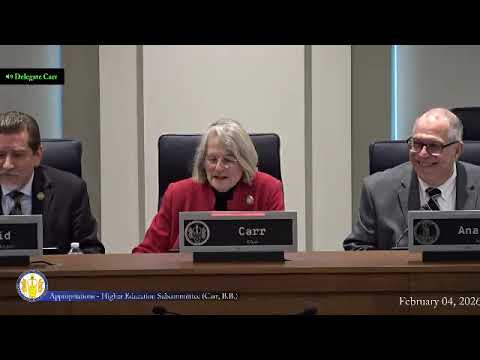
Subcommittee delays change to VTAG eligibility that would add Virginia University of Lynchburg
Summary
The subcommittee heard HB 1354, a narrow proposal to allow Virginia University of Lynchburg to qualify for the VTAG program by recognizing national accreditation agencies approved by the U.S. Department of Education; lawmakers praised the institution but laid the measure on the table to address budget and technical issues.
HB 1354, introduced to update the VTAG (state tuition-assistance) eligibility definition to include nonprofit private HBCUs accredited by a U.S. Department of Education–recognized national accreditor, was presented and supported in testimony but not advanced at this hearing.
The president of Virginia University of Lynchburg (speaker 15) told the subcommittee the 140‑year HBCU enrolls roughly 850 students (95% identifying as African American) and that current VTAG rules exclude the university’s students from an existing state tuition-assistance program. James Coleman, dean and speaker 18, and other supporters framed the change as an equity and access issue for Virginia residents, saying the adjustment would bring an estimated 150–300 students into eligibility and would have minimal fiscal impact because VUL is small.
Patron Delegate Walker described the bill as narrowly tailored to permit one historic institution to qualify under the VTAG program by accepting accreditation from a USDE‑recognized national accreditor; the sponsor said the bill does not broadly expand eligibility. Committee members asked analysts about the current accreditation criteria and how this institution differs from others that have applied for VTAG in the past.
A motion to gently lay the bill on the table was made and seconded; the clerk was called to open the roll, and the subcommittee concluded with an adjournment. The transcript shows the bill was thanked and the sponsor invited to continue work with members; the final roll-call tally was not clearly recorded in the published segment.