
Subcommittee delays student-loan program for physicians amid budget concerns
Get AI-powered insights, summaries, and transcripts
Subscribe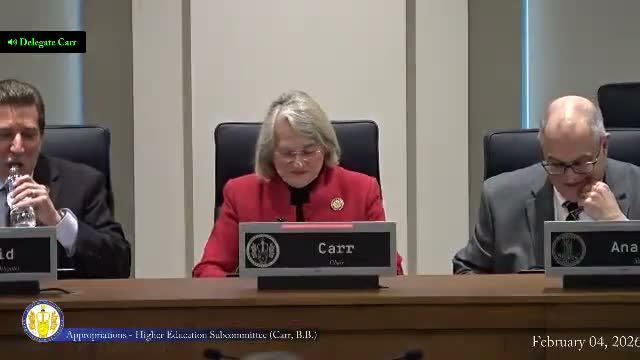
Summary
HB 663, a sponsor-backed plan to permit up to $50,000 per year in state-backed student loans for medical students who commit to practice in high-need specialties in rural/underserved Virginia areas, drew broad support from medical societies and students but was laid on the table 5–2 due to fiscal concerns.
House Bill 663, which would create a program allowing students to borrow up to $50,000 per year (described by the sponsor as up to about $200,000 over a four-year degree) in exchange for service in high-need specialties in rural or underserved areas, received extensive testimony but was tabled by the subcommittee.
The bill’s sponsor described the program as focused on shortages in specialties such as OB/GYN and other high-need areas, and said the cost of medical education (cited at roughly $220,000 in testimony) is driving students away from primary care and rural practice. The sponsor characterized the proposal as non-duplicative of existing loan-repayment programs and modeled on similar pipeline approaches used in other states.
The Medical Society of Virginia (Colleen Grady) told the panel the state faces a tipping point in its physician workforce and noted that Virginia lacks an active, dedicated physician workforce program; she cited data that in 2024 the state health department received 277 applications to an existing program and awarded 62 grants, only five to physicians. Student witnesses described high, sometimes six-figure debt burdens — one student, Jake Mikesell, said he carries $425,000 in student debt — and urged passage.
Representatives from hospitals and specialty societies — including the Virginia Hospital and Healthcare Association, the American College of Obstetricians and Gynecologists, the Virginia College of Emergency Physicians, the Virginia chapter of the American Academy of Pediatrics, Virginia Tech Carilion, UVA Health, and several academic medical centers — described rural-recruitment and retention problems and endorsed the proposal. A family physician who trains residents also testified that residency losses are occurring because Virginia cannot support needed positions.
A committee member said the measure is compelling but that current budget uncertainty and federal cuts justify deferring adoption; a motion to "gently lay this on the table" was made, seconded, and the chair announced the bill was tabled by a 5–2 roll-call vote. The record shows a technical amendment to HB 663 was adopted earlier in the hearing.
The subcommittee did not adopt the program into the budget and advocates were encouraged to continue engagement with members.