Get Full Government Meeting Transcripts, Videos, & Alerts Forever!
Get email alerts on the Healthcare Licensing topic
No spam. Unsubscribe anytime.
Senate committee advances bill defining dry needling, sets 50‑hour training minimum
Summary
The Senate Services Committee advanced Senate Bill 411 (LC520991S), which defines "dry needling," distinguishes it from traditional acupuncture, requires a minimum of 50 hours of training for occupational and physical therapists, and clarifies that truth‑in‑advertising language is not intended to create a private cause of action.
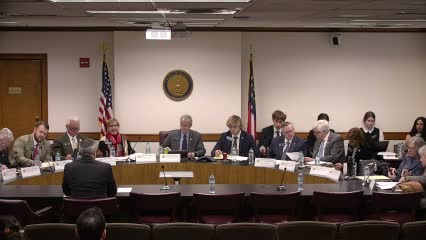
The Senate Services Committee advanced a bill that defines "dry needling" and establishes training standards for therapists, the committee chair announced after a voice vote.
Senator Still, the bill's author, told the committee the substitute to Senate Bill 411 (LC520991S) draws a clear distinction between dry needling and traditional Chinese medicine acupuncture and incorporates a definition developed with the Georgia Medical Licensing Board. "So what the bill does is it first and foremost, you know, it defines what that is," Senator Still said.
The bill includes a truth‑in‑advertising provision that, according to Senator Still, is not intended to create a private cause of action between practitioners. He said the language was adjusted at the request of legal advisers to avoid unintended litigation and to preserve existing remedies for patients harmed by improper care. "If you go through the lung field... it's called a pneumothorax," Senator Still said as an example of a clinical complication that could give rise to a malpractice claim.
Section 3 of the bill sets a minimum training requirement, stipulating that "no OT shall do it unless they've had a minimum of 50 hours," Senator Still said. He described the change as an effort to standardize education for occupational therapists and physical therapists so they meet the same baseline for performing dry needling.
Committee members praised the compromise. One member congratulated Senator Still for convening occupational therapists, acupuncturists and physical therapists after earlier attempts had not succeeded, and Senator Orrock noted the long history of debate over acupuncture and related practices in Georgia.
A committee member asked whether lines 38–40 of the substitute would create a private cause of action. Senator Still and the chair clarified that the bill does not eliminate malpractice remedies and that the truth‑in‑advertising language was intended to prevent misleading titles, not to create a new practitioner‑to‑practitioner lawsuit.
A motion for a "do pass" recommendation on LC520991S was made and seconded by Senator Orrock. The chair called for a voice vote; members responded "aye," and the chair recorded the vote as unanimous, advancing the bill out of committee.
During the committee's good‑and‑welfare period, Senator Kirkpatrick introduced Dr. Bala, a third‑year emergency medicine resident at Emory who will be doing a health policy fellowship next year. The committee adjourned and will reconvene Wednesday.
Votes and procedural actions described in this article are taken from committee remarks and the committee's voice vote as recorded in the meeting transcript.