Get AI Briefings, Transcripts & Alerts on Local & National Government Meetings — Forever.
Senate committee advances bill to expand rules for delivery robots, keeps local control
Loading...
Summary
The Senate Transportation and Safety Committee advanced SB1625 after adopting an amendment that preserves local authority while allowing low-speed autonomous delivery devices in bike lanes and at the side of the road, raising off-sidewalk speeds to 20 mph and prohibiting interstate travel.
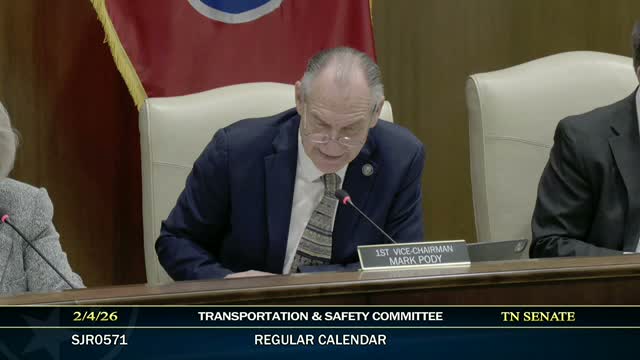
The Senate Transportation and Safety Committee voted to advance SB1625 on a 9-0 vote after adopting an amendment clarifying local regulation and safety limits for personal delivery devices.
The bill, as explained to the committee, updates Tennessee’s 2020 personal delivery device (PDD) law to reflect newer delivery robots that operate at slightly higher speeds and in locations beyond sidewalks. Brent Westcott, director of policy development at DoorDash, told the committee that the company’s DOT robot ‘‘uses leading autonomous technology to ensure that it can safely navigate neighborhood streets’’ and said the vehicle is ‘‘subject to human monitoring, and a human can intervene whenever necessary.’’ He also said DoorDash saw nearly 12,000 Tennessee businesses on its platform and more than 44,000,000 orders in 2024.
Under the amendment read into the record (spoken as "amendment number 1 2 6 9 0"), the bill clarifies that the devices may operate in bike lanes and on the side of the road, may use crosswalks only if programmed to identify signage and yield appropriately, and may travel off sidewalks at speeds up to 20 mph. The amendment also reaffirms that local governments retain authority to regulate or prohibit deployment within their jurisdictions; the committee repeatedly noted that the measure does not mandate deployment in any community. The bill also specifies that the devices cannot travel on the interstate.
Senators asked about safety records and local authority. Westcott told the committee that DoorDash has had ‘‘no safety critical incidents’’ in markets where similar devices are deployed, describing only minor noncritical issues such as hitting curbs while turning. Committee members pressed on how the revised law differs from the 2020 statute; witnesses and sponsors said the primary changes are where devices can operate and the higher off-sidewalk speed cap.
The committee approved the amendment by voice vote and then advanced SB1625 to the calendar in a roll-call vote that recorded ayes from Senators Bailey, Briggs, Campbell, Hatcher, Pote (Poteet), Powers, Seale, Taylor and Chairlady Massey. The committee’s action is procedural: the bill was advanced from committee and will face the legislature’s next scheduled steps for floor consideration.
Votes at a glance: the amendment passed by voice; the committee’s roll-call on the bill recorded nine ayes and no nays.