
Tennessee committee rejects bill to lock in continuous TennCare coverage for children
Get AI-powered insights, summaries, and transcripts
Subscribe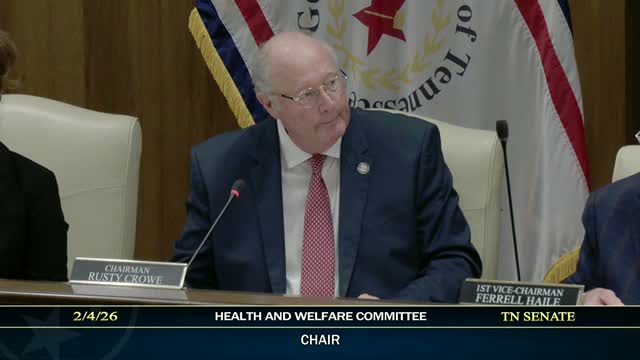
Summary
A proposed law to automatically preserve TennCare coverage for eligible children through age 18 failed in a Tennessee Senate committee after questions about federal matching funds and program scope; sponsor said it aims to close paperwork-driven coverage gaps.
Senate committee members voted down a proposal to make TennCare coverage continuous for children through age 18, raising questions about federal funding and the bill's practical effects.
Sponsor Senator Lamar told the committee that Senate Bill 401 "establishes continuous eligibility for children 18, allowing coverage to renew automatically unless a child's eligibility actually changes," and framed the measure as a program-stabilization effort rather than an expansion. Lamar cited the State of the Child report and told members that 6.5% of Tennessee children were uninsured in 2024 and that the bill could extend coverage to roughly 59,000 eligible children at an estimated state cost of $15,000,000 (about $250 per child annually).
TennCare witnesses outlined how the current process works. "Automatically after 9 months, TennCare will try to renew your coverage, through what's called our Tennessee eligibility determination system, also known as TEDS," said TC Becker, legislative liaison for TennCare, describing automated renewals and subsequent notice and reconsideration windows. Becker said TennCare had been able to renew roughly "83 percent of children, through that no touch system." He warned that a state-only continuous-coverage approach could lose federal matching funds: "we would just need all state dollars in order to implement the program," he said, referencing a CMS letter indicating the agency would not approve similar waivers going forward.
Committee members pressed on several operational points. Senator Hensley asked whether the bill would mean children "stay on TennCare without any redetermination till they were 18" and whether the state would then bear full costs; TennCare confirmed the state would be responsible for coverage without federal matching if CMS declined a waiver. Senator Yarbrough and others debated whether the bill prohibits sending confirmation requests to families; TennCare and members disagreed on whether voluntary confirmation would preserve federal matches in all cases.
Sponsor Lamar pointed to explicit bill language intended to avoid contravening federal law and listed exceptions that would allow disenrollment if TennCare has knowledge of a parent-requested disenrollment, death, a move out of state, or family income exceeding eligibility limits.
When the committee took a roll-call vote, the secretary recorded three ayes (Senators Massey, Yarbrough and Chairman Crowe) and six noes (Senators Hale, Harshbarger, Hensley, Jackson, Reeves and Watson). The chair announced the result as "3 ayes, 6 nos," and the committee did not advance the measure.
The sponsor characterized the bill as targeting administrative churn that causes eligible children to lose coverage; opponents argued the measure, as written and in light of CMS guidance, posed fiscal and administrative risks. There was no final committee direction to develop a compromise amendment during the hearing.