
Subcommittee advances bill allowing waivers of Florida minimum wage for limited work‑based training amid legal and enforcement concerns
Get AI-powered insights, summaries, and transcripts
Subscribe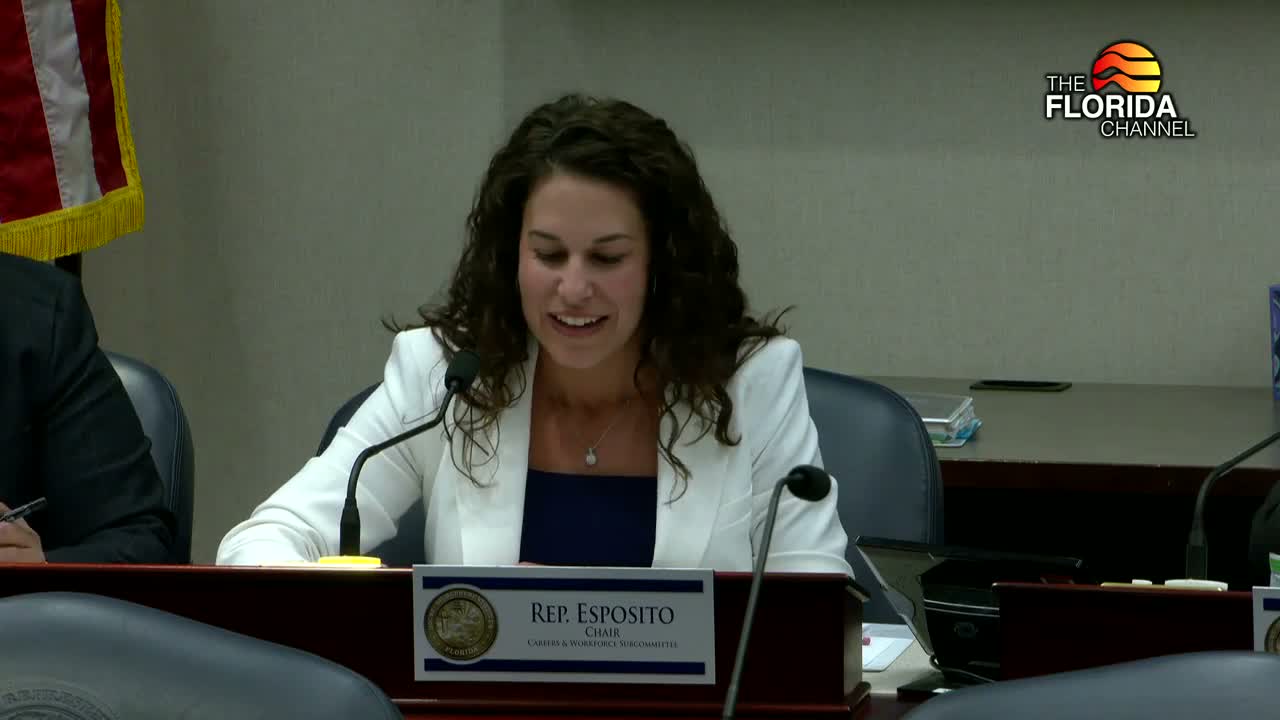
Summary
The House Career and Workforce Subcommittee voted 11–5 to report CS HB221, which would let workers voluntarily waive Florida's constitutional minimum wage for limited, structured work‑based training programs. Opponents—including unions, students and NAACP representatives—said the bill lacks oversight and may conflict with the state constitution and federal law.
A Florida House subcommittee on Friday advanced a bill that would let employees voluntarily waive the state constitutional minimum wage while participating in limited, structured work‑based learning programs.
Representative William Chamberlain, sponsor of CS HB221, told the Career and Workforce Subcommittee the measure creates “on the job workforce training” opportunities for people who do not pursue college degrees. He said the bill would allow businesses to offer time‑limited, documented training in exchange for an employee’s decision to forgo the state minimum for that period and that the measure “creates unique pre apprenticeship opportunities that are defined and structured that currently don't exist.”
The chamber vote to report the bill favorably was 11 yes and 5 no.
Opponents at the subcommittee hearing said the bill would enable employers to undercut wages and lacks enforcement to ensure training is educational rather than inexpensive labor. Shane Tremblay, a construction electrician from Jacksonville, said his apprenticeship paid living wages and warned the bill “undermines the whole point of a minimum wage” by creating a route to lower pay. Theresa King, president of the Building and Construction Trade Council, urged removal of the term “pre‑apprenticeship” from the bill and said registered apprenticeships should not require sub‑wage pay.
Dr. Rich Templin, speaking on behalf of organized labor, praised workplace training generally but said the bill provides no mechanism to verify that employers’ programs meet educational standards. “Who enforces it? Who actually looks at the plan that an employer has to validate that it's actually work study, it's actually career development, and not just cheap labor?” he asked.
Several committee members raised legal questions. Representative Gantt said the bill appears to allow waiving a right created by the Florida Constitution and argued the proposal contains no permissive language allowing such a waiver. Gantt also warned that, as drafted, “the language in this bill sets it at $6.15,” which she said would conflict with the federal Fair Labor Standards Act and could render the bill unconstitutional or preempted by federal law.
Sponsor Chamberlain said the bill does not lower the state minimum wage for existing jobs and that employers could not reclassify current positions to avoid pay requirements. He described the program as voluntary and said it includes limits and documentation requirements — a maximum duration (presented in the bill text as 252 days or two semesters/9 months), special shorter limits referenced for minors, required documentation of learning objectives and performance assessment, and parental or guardian signatures where specified in the bill language.
Public testimony at the subcommittee was predominantly opposed. Nick Mangoni of Gainesville called the bill “a direct attack on the Florida constitution,” saying voters had approved a $15 minimum wage and that the measure substitutes administrative discretion where the constitution sets a floor. Nicole Sparrow, representing the Flagler County NAACP, said reduced pay for apprenticeships would harm families who rely on trainees’ wages.
The sponsor closed by inviting members to work on clarifications and said he would meet with concerned colleagues to address enforcement and definitional issues. After debate and testimony, the subcommittee voted 11–5 to report CS HB221 favorably.
The subcommittee’s action means the bill moves out of the Career and Workforce Subcommittee with a favorable recommendation; the record shows the sponsor and several members indicated an intent to refine language addressing enforcement and statutory references before later stages.