Get Full Government Meeting Transcripts, Videos, & Alerts Forever!
Get email alerts on the Commercial Pace topic
No spam. Unsubscribe anytime.
Committee hears fix for PACE lien enforcement to preserve commercial clean‑energy financing
Summary
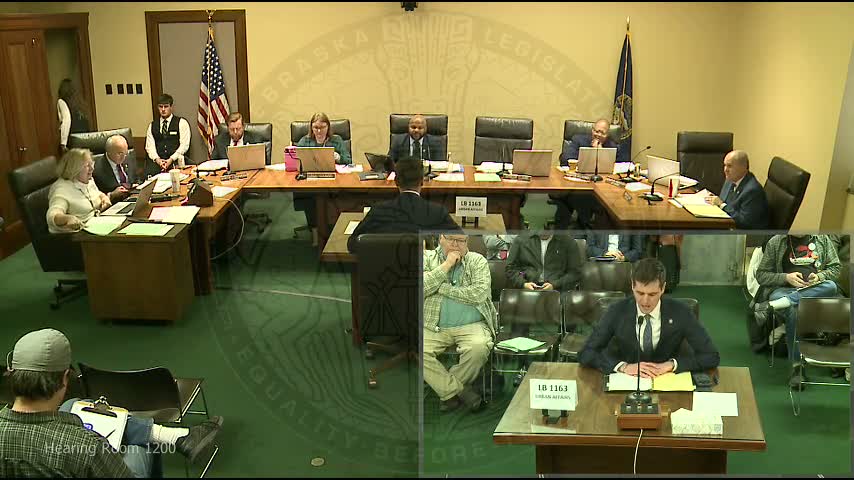
Sen. John Frederickson said LB 11‑63 clarifies that delinquent commercial PACE (CPACE) assessments are collectible like property taxes, aiming to remove county uncertainty that has chilled private CPACE investment.
Senator John Frederickson told the Urban Affairs Committee LB 11‑63 is a targeted technical amendment to Nebraska's PACE statutes to make explicit that delinquent CPACE assessments can be enforced by cities and counties following property‑tax collection procedures. He said that ambiguity has discouraged investment because counties lacked explicit authority to enforce delinquent CPACE assessments.
Frederickson said CPACE has supported over $150 million in private investment in Nebraska since its 2016 enactment and cited active programs in Beatrice, Columbus, Fremont, La Vista, Papillion and Norfolk. Committee members pressed about the practical implications for property owners and whether PACE liens could lead to foreclosure. Michael Yockey of Petros PACE (SEG 1762) told the committee the bill only applies to commercial properties and that while PACE assessments are special assessments, counties need clear statutory authority to process delinquent assessments in the same way as property taxes. He explained that in enforcement waterfall scenarios, property taxes remain first in priority for recovery and special assessments (including CPACE) would follow.
County and municipal representatives urged clarity so CPACE lenders will continue to deploy capital for energy‑efficiency and renewable investments in commercial buildings. The committee did not take a vote; supporters asked the committee to adopt the clarification to preserve the state CPACE market.