
Austin Water briefs council committee on emergency management, credits preparedness for limited impacts during recent winter storm
Get AI-powered insights, summaries, and transcripts
Subscribe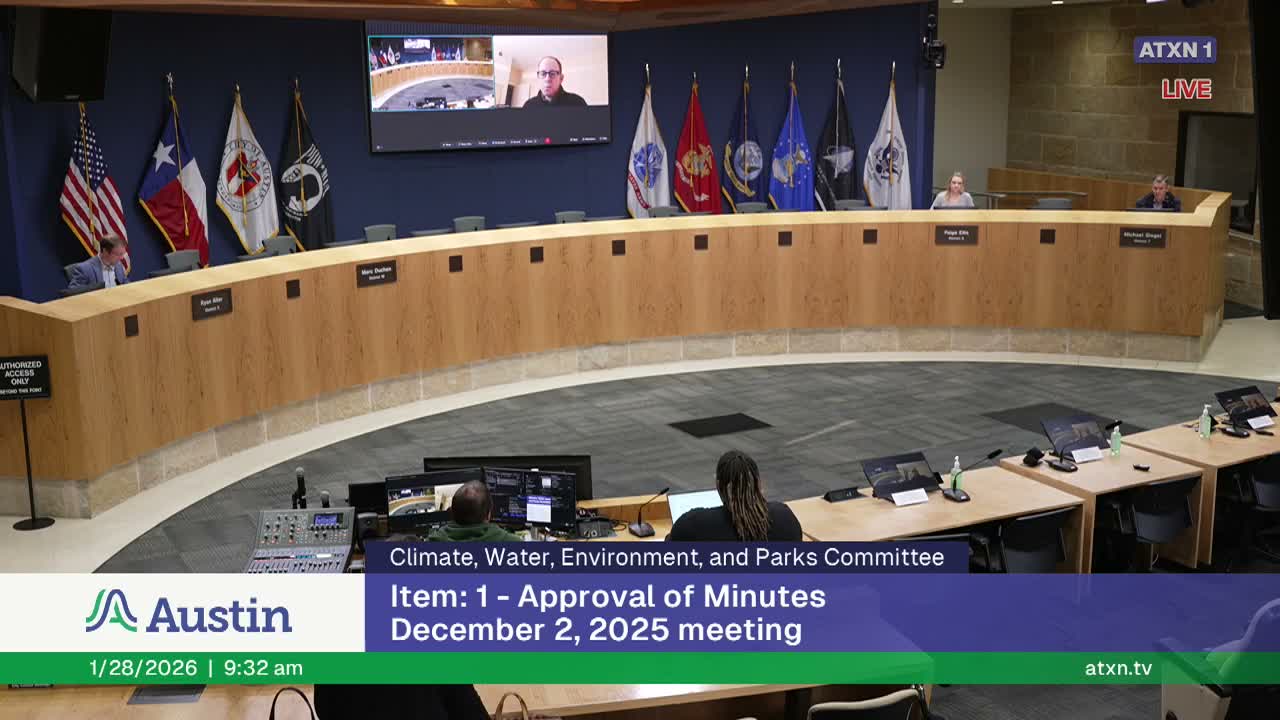
Summary
Austin Water told the Climate, Water, Environment and Parks Committee that its all‑hazards program, expanded communications capacity and winter preparedness measures helped the utility maintain generally normal operations during a recent frozen‑precipitation event. Staff outlined equipment, training and outreach tools, and advised residents on reporting outages.
Austin Water officials told the City of Austin Climate, Water, Environment and Parks Committee on Jan. 28 that the utility’s all‑hazards emergency management and winter preparedness work helped it navigate a recent frozen‑precipitation event with largely normal operations.
Director Shay Rawls Rolson opened the briefing, saying the presentation would show how the department’s preparedness was tested and where investments had paid off. ‘‘We thought it would be nice to bring you a presentation on the Austin Water emergency management and preparedness, the all hazards approach that we take to be ready,’’ she said.
In an overview of operational readiness, Emergency Management Division Manager Rick Beeman described Austin Water’s use of the Incident Command System and a continuous emergency‑management posture that can be ‘‘turned up and down’’ rather than switched on and off. Beeman said the utility uses VOC reporting software for daily operations and emergencies, maintains nearly 200 staff trained for incident‑management roles across 34 filled positions, and stages emergency equipment including potable water tankers, hydrant taps and on‑site shelter supplies. ‘‘We maintain 235,000,000 gallons a day for system readiness and use,’’ he said.
Amy Petrie, Austin Water’s interim chief of staff and public information manager, described emergency communications and outreach tools: prewritten regulatory messaging for boil‑water and do‑not‑drink advisories, FAQs translated into 15 languages, geo‑targeted alerts through the myATX water portal, coordination with the City’s communications office for citywide news flashes, and a deputy incident commander role focused on communication and liaison duties during activations.
Stephanie Hsu, operations manager for water treatment plants, reviewed winter‑specific actions: inspections on insulation and heat tracing, heaters added to solids‑processing equipment after 2021’s Winter Storm Uri, alternative chemical delivery routes to address access constraints, and a newly tied‑in substation at a major treatment plant to strengthen power resiliency. Hsu said some staff sheltered in place at facilities during the recent event to maintain operations.
During committee Q&A, staff reiterated constituent guidance: customers should report visible leaks or outages by calling Austin Water’s customer service contact center at 972‑1000. Petrie noted that myATX portal users who have contact info tied to their accounts will receive emergency notifications, while apartment residents are reached in partnership with Austin Energy because the utility does not hold tenant contact lists.
The briefing included an emphasis on after‑action review and continuous improvement. Rawls Rolson and her team said many of the systems and equipment used during the recent storm were investments made after Winter Storm Uri in 2021 and that those changes — from AMI meter deployment to maintained water tankers and a communications deputy role — were operationalized to speed responses and reduce customer impact.
The committee opened no formal votes on policy during the briefing; the meeting had earlier approved minutes by motion.
What’s next: staff said they would follow up with council on a pending question about best practices for building fire suppression systems and would share web links and materials staff referenced for constituent distribution.