Get Full Government Meeting Transcripts, Videos, & Alerts Forever!
Get email alerts on the Bond Funds Status topic
No spam. Unsubscribe anytime.
Staff: $2.45 billion in bond programs; $166 million housing balance uncommitted, $790 million in CEO authorizations
Summary
City staff told the Audit & Finance Committee on Feb. 3 that the 2012''2 general obligation bond programs total $2.45 billion in appropriations with $1.5 billion spent so far; housing has about $166 million uncommitted and certificates of obligation and related non-voter debt authorizations exceed $790 million.
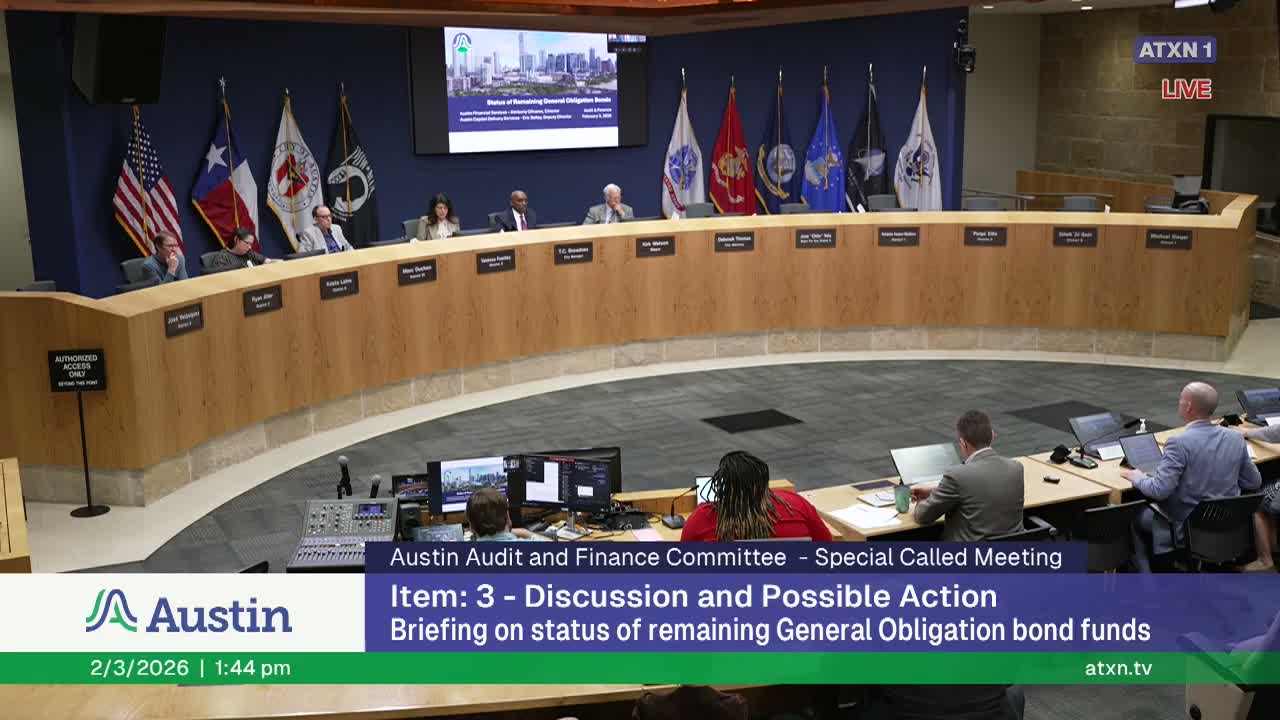
City staff briefed the Austin Audit & Finance Committee Feb. 3 on the status of remaining general obligation (GO) bond funds from 2012 through 2022 and on non-voter debt authorizations.
Eric Bailey, deputy director for Capital Delivery Services, told the committee the combined bond programs include a total appropriation of $2,450,000,000 across more than 1,200 projects; about $1,500,000,000 has been spent and the city has completed more than 700 projects. Bailey said remaining balances are concentrated: "about 20 projects that account for 60% of the non housing bond balance," and he outlined expected design and construction timetables for several corridor and transportation projects.
Housing staff said roughly $166,000,000 of 2022 bond funding for affordable housing remains uncommitted. Nicole Joslin, Housing and Community Development Officer, said a portion of bond funds are committed to projects that have not yet closed, and other funds have been programmed into upcoming competitive application cycles. Mandy DeMaio, deputy director in Housing, said the department originally programmed spending across five years but is now projecting a six-year spend plan to align with the committee's recommended six-year cadence.
Kim Olivares, director of Financial Services, described the city's remaining non-voter general obligation authorizations (certificates of obligation and contractual obligations) as ‘‘just over $790,000,000," covering categories that include facility renovations, land acquisition, parks and transportation. Olivares emphasized that certain funds are supported by dedicated revenue streams (for example, Colony Park and Waller Creek projects supported by project revenues) while others affect the debt-service portion of the property tax rate.
Olivares also briefed council members on reallocation and deauthorization rules. She said bond funds must be used for one of the purposes named in the original proposition and cannot be repurposed to an unrelated proposition without additional council or voter action. On deauthorization, staff said two main options exist: place deauthorization on the ballot for voter action, or, where programmatic appropriation allows, sweep unspent amounts into similar uses without a ballot measure; staff noted a 10-year "staleness" window in AG guidance that typically informs deauthorization decisions.
Committee members asked staff to develop dashboards and a strategic implementation plan to improve deliverability and public transparency; staff said it expects to complete a strategic implementation plan and supporting tools over the coming months to aid decisions about 2026 bond timing.