
Austin council work session probes LiveView park camera contract as residents and advocates raise privacy and equity concerns
Get AI-powered insights, summaries, and transcripts
Subscribe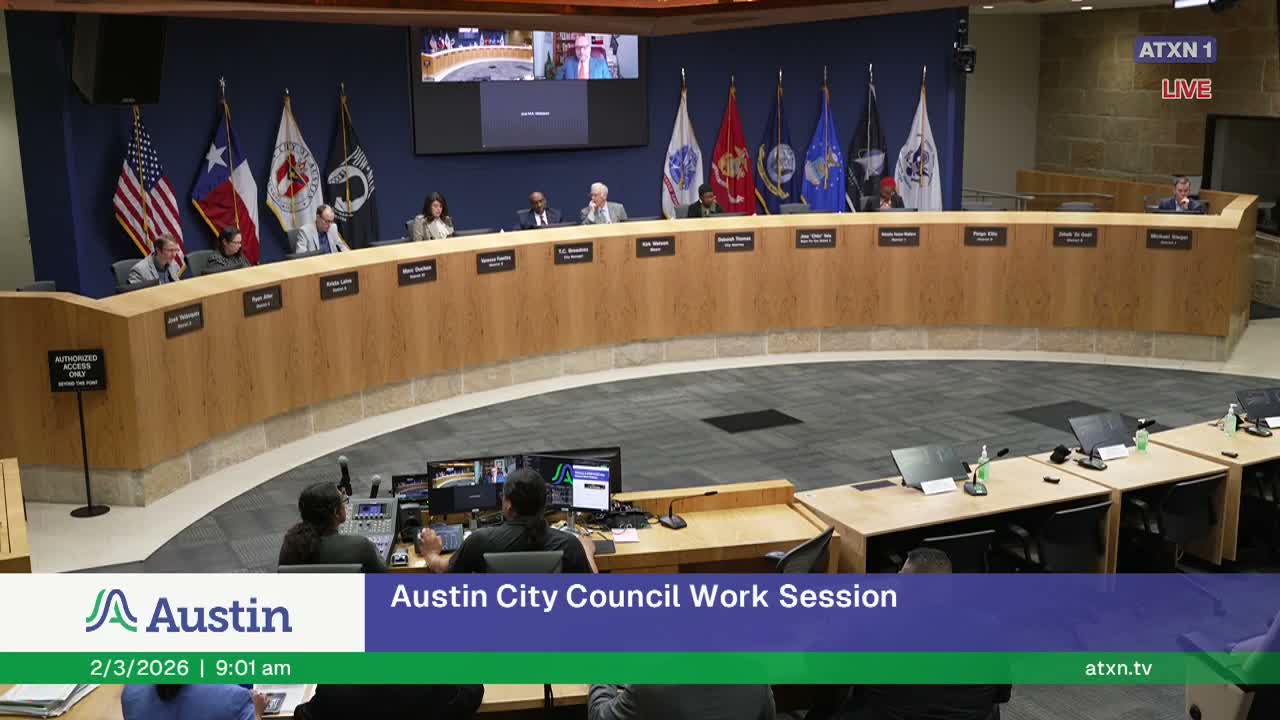
Summary
Public commenters and several council members urged caution on a proposed LiveView Technologies mobile camera contract (item A3), citing risks to immigrant communities, data custody, and insufficient contractual safeguards; staff said AI features would be disabled by default and an addendum is in negotiation.
Councilmembers and dozens of public speakers spent the bulk of the Feb. 3 Austin City Council work session debating a proposed contract to rent mobile surveillance cameras for city parks, focusing on whether the technology and the proposed agreement would protect residents’ privacy while actually reducing crime.
The debate centered on item A3, a parks-department plan to rent 6–10 mobile camera trailers seasonally to target parking-lot theft and other park crime. Proponents pointed to pilot results and casework; opponents warned the cloud-hosted, AI-enabled system hands sensitive data to a private vendor and could be repurposed for immigration or other enforcement.
Why it matters: Councilmembers said they want to balance two urgent aims—reducing violent and property crimes in public parks and protecting residents’ civil liberties. Several speakers, including immigrant-advocacy and civil-liberties groups, argued the proposed contract as written does not guarantee that data won’t be accessed by federal agencies. Staff said contractual addenda and technology controls are being negotiated and that the city would not proceed unless required privacy and security terms are agreed to by the vendor.
Parks staff and security experts defended safeguards. Amanda Ross, division manager for Parks and Recreation, said the contract requires certain AI features to be disabled and that staff can revise contract language. Dr. Brian Gardner, interim chief information security officer, said features that would enable correlation or facial-recognition workflows would not be enabled; he described privacy-impact assessments and security controls such as encryption and multifactor authentication. Assistant Chief JJ Schmidt of the Austin Police Department said footage would be incorporated into APD evidence systems (Axon) and managed under existing evidence-retention and CJIS protocols.
Speakers for and against. Supporters including neighborhood association leaders said temporary cameras had correlated with reduced vehicle break-ins at pilot locations. Linda Bailey said vehicle break-ins dropped by roughly 60% when cameras were placed at some park overlooks. APD commander Craig Smith described a Mount Bonnell investigation where park cameras helped identify a burglary ring and led to arrests.
Opponents cited national examples of surveillance data being repurposed and highlighted equity and civil‑liberties risks. Marina Roberts of Workers’ Defense Action Fund described tools and data-broker chains that she said feed enforcement apps; several speakers invoked a recent staff memo and expressed concern that contractual promises in that memo had not yet been finalized and reviewed by the law department. Kenneth Welch of EFF Austin said, "the only data that is safe is the data that is not collected." Parents and local advocates said they feared images of children and other vulnerable residents entering an AI database.
Outstanding questions and next steps. Councilmembers pressed staff on specific contract items: whether the vendor had agreed to language prohibiting use of city video for AI training, whether the privacy analysis would be published two weeks before any council vote, and whether the surveillance-use policy (the Trust Act) should be adopted first and used as a standard for this contract. Staff said an addendum containing privacy protections is in draft and negotiations are ongoing; staff and the auditor’s office said the city would not advance the contract if required protections were refused.
Several council members asked to delay a vote to allow publication of the privacy/security analysis and additional refinements to the contract. Mayor Pro Tem Chido Vela recounted violent incidents at Zilker Park and urged solutions that protect public safety; other council members stressed transparency and worker/community input. The council did not vote on A3 during the work session and signaled it would continue the discussion before any final approval.
What’s next: Councilmembers requested a clearer initial deployment plan (which parks would be prioritized), a timeline and cadence for evaluation (monthly reporting was suggested), and the public posting of the privacy impact analysis and proposed addendum prior to a final vote. Staff said the contract envisions seasonal rentals (goal: 6–10 trailers) and that placements would be data-driven. The council also discussed testing the contract as an initial case under the proposed surveillance-use policy.
Quotes: "The data get moved to the custody of the city of Austin in some kind of service that we can maintain...so we can have oversight as a citizenry," said Austin Wright during public comment. "We have an addendum to the contract that took the privacy and technology review and made recommendations...it is currently a draft," Amanda Ross told the council. "Those features will not be enabled... it will be purely bringing the data into the servers, encrypting the data, [with] controlled access," said Dr. Brian Gardner, interim chief information security officer. "We were able to use the park cameras and get the suspects identified...with that evidence, we're able to gather what the suspects look like and develop a case," said Commander Craig Smith of APD.
Ending: Councilmembers left the work session without voting on item A3 and asked staff to return with finalized contract language, published privacy/security analyses, and a clear deployment and evaluation plan before a final council vote.