
State analyst tells McLeod County commissioners students are central to workforce strategy
Get AI-powered insights, summaries, and transcripts
Sign Up Free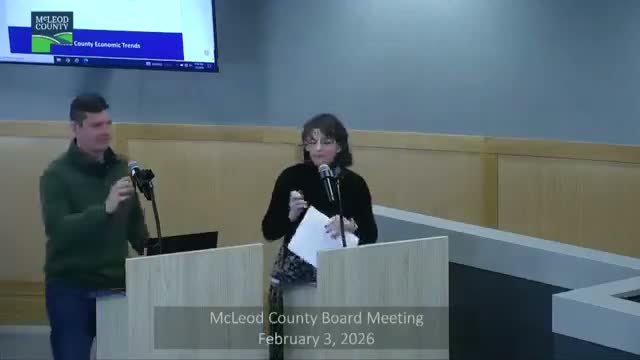
Summary
Luke Greiner, a labor market analyst with the Minnesota Department of Employment and Economic Development, told McLeod County commissioners on Feb. 3 that slower labor‑force growth and a growing mismatch between student career interests and local jobs mean counties should coordinate schools and employers to keep and prepare local students for available work.
Luke Greiner, a labor market analyst with the Minnesota Department of Employment and Economic Development, told the McLeod County Board of Commissioners on Feb. 3 that students are the most important near‑term source of new workers for the county.
Greiner reviewed December and 2024 data showing the Minnesota unemployment rate has risen modestly to about 4 percent and that manufacturing and construction remain important local employers. He said employers increased advertised starting wages sharply in recent years but that wage growth did not always translate into greater purchasing power for current workers. "If we want to keep our businesses in our communities or attract new ones, you're going to have to make a case that you have new workers being minted at your local high schools," Greiner said.
Greiner highlighted a recurring mismatch: relatively few students express interest in manufacturing or STEM occupations despite those sectors representing a large share of available jobs locally. He cited his student survey work and said career exploration and stronger school‑business partnerships can help close the gap. He noted cost‑of‑living calculations for McLeod County: a typical two‑adult, one‑child family would need roughly $61,000 in combined annual earnings to cover a baseline, "safe and healthy" lifestyle; a single person would need roughly $31,000.
Commissioners asked for practical follow‑ups: how job postings are accessed, the role of local workforce partners such as Central Minnesota Jobs and Training, commuting patterns for county workers, and options for engaging schools and families. Greiner said the state maintains MinnesotaWorks and other tools, that local career force locations (for example in Hutchinson) can help job seekers, and that the department can pull commuting and place‑of‑work data for county staff. He encouraged commissioners and business leaders to use their networks to promote local career resources and to participate in local school career events.
Greiner also described two new surveys the department is running—one of job counselors and one of economic development professionals—to collect qualitative insights about hiring and job‑seeker experiences. Slides and data dashboards referenced during the presentation are available from DEED, Greiner said.
The presentation prompted extended discussion about housing, regional commuting, and student retention. Commissioners noted the county’s limited labor‑force growth projections (roughly 2.5 percent over the next decade) and said workforce strategy will need to account for commuting patterns, housing availability and school‑based career programming. The board took no formal action on the presentation; staff and commissioners indicated they will use the data in upcoming economic and housing forums.