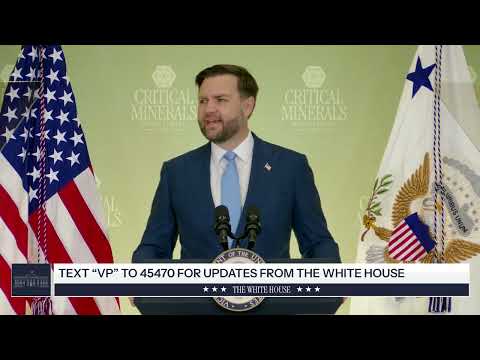
Vice President JD Vance proposes allied preferential trade zone with price floors for critical minerals
Loading...
Summary
At a Washington ministerial, Vice President JD Vance urged allied countries to form a preferential trade zone for critical minerals that would use enforceable reference prices and adjustable tariffs as price floors to stabilize markets, protect domestic manufacturers and encourage long-term investment.
Vice President JD Vance urged ministers and senior officials gathered at a U.S.-hosted critical minerals ministerial in Washington to create a preferential trade zone that would stabilize global markets and shield allied producers from disruptive imports.
Vance opened by framing critical minerals as foundational to the modern economy and national security, saying the group in the room represents “close to two thirds of the world’s GDP” and that allied coordination can reduce brittle, concentrated supply chains. He argued that unpredictable prices and sudden foreign supply can stall or kill projects, deterring investment in mining and processing.
The centerpiece of Vance’s proposal was a bilateral and multilateral trading arrangement that would set reference prices at each stage of production and maintain those levels through adjustable tariffs. “We will establish reference prices for critical minerals at each stage of production, pricing that reflects real world fair market value,” he said, describing the reference prices as a floor maintained through tariffs for members of the proposed zone.
Vance said the mechanism would prevent flood imports from artificially depressing prices, which then cause domestic projects to fail and later allow prices to be raised sharply. He framed the approach as a way to create predictable conditions that attract long-term private financing and enable domestic and allied production to scale.
He also pointed to U.S. financing tools and initiatives designed to support such supply chains, including public financing at scale and a domestic stockpile, and urged hesitant partners to join the effort quickly so the preferential zone can yield durable investment conditions.
Next steps: Vance asked ministers to use the ministerial’s talks to finalize agreements and sign on to the framework; the ministerial proceeded to plenary sessions for detailed negotiation and implementation planning.