Lifetime Citizen Portal Access — AI Briefings, Alerts & Unlimited Follows
Arts commission approves broad updates to Art in Public Places ordinance, urges clearer contracts and maintenance plan
Loading...
Summary
The Austin Arts Commission voted to recommend city council adopt staff-updated Art in Public Places (AIPP) ordinance and guidelines that clarify definitions, add alternate-delivery language for P3s, propose greater flexibility for bond-level funds, and formalize accession/deaccession and maintenance processes.
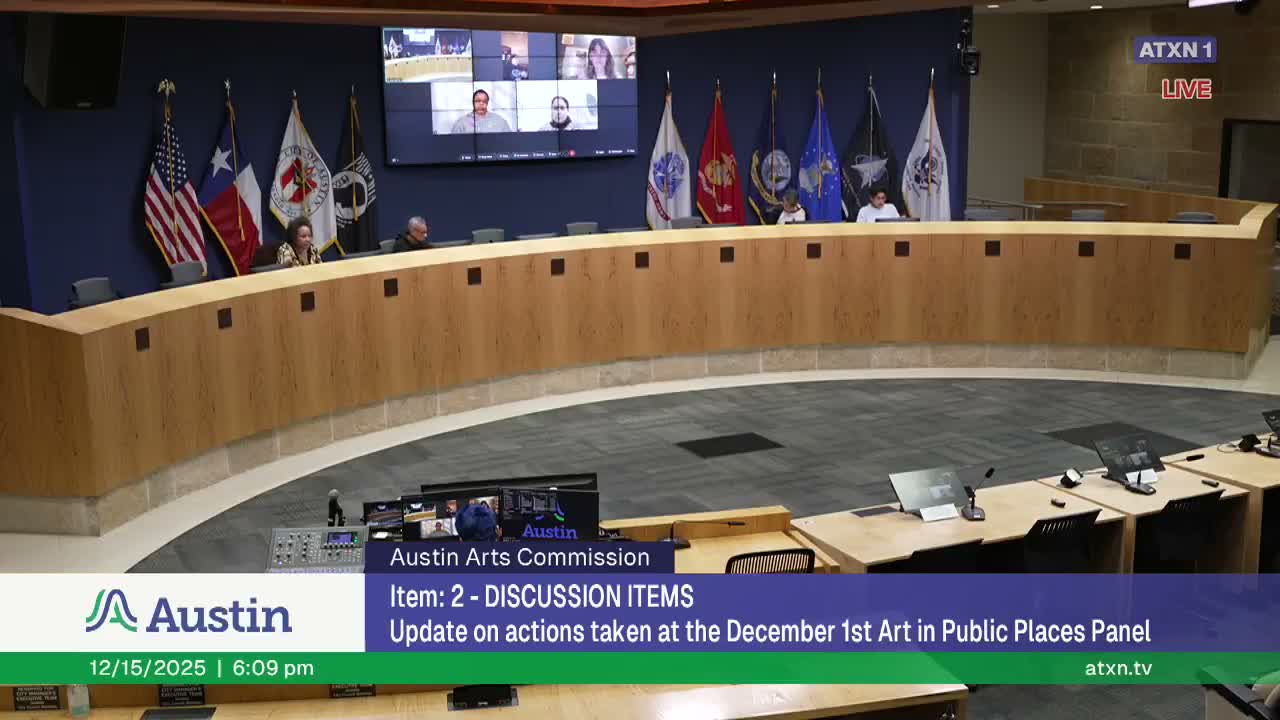
The Austin Arts Commission on Dec. 15 approved a staff recommendation to send updated Art in Public Places (AIPP) ordinance language and accompanying guidelines to city council, advancing a multi-phase review prompted by a March council resolution.
Jaime Castillo, Art and Public Places manager, told commissioners the review proceeded in phases: a program assessment, working-group recommendations and legal review before submittal. He said the updates aim to increase local-artist participation, clarify how the percent-for-art calculation is applied and make communications more transparent. "We updated and added new definitions, updated the term construction cost to capital project cost," Castillo said, adding staff incorporated "alternate delivery models such as P3s or the Austin Public Facility Corporation" as the council requested.
The recommended ordinance changes include: clarifying that the percent-for-art base is capital project cost rather than a generic construction-cost term; incorporating alternate-delivery language to capture P3s and similar models; removing a cap that limited participation by Austin Water/wastewater facilities and adding alternate-compliance language; and allowing greater flexibility—at the bond-proposition level—for locating and combining 2% allocations from eligible projects.
Castillo also presented programmatic proposals that do not require ordinance changes: an annual maintenance report to track repairs and restoration, clearer delineation of maintenance responsibilities between sponsor/user departments and AIPP, and a tiered artist-call structure to broaden opportunities for emerging artists. He described updates to accession and deaccession language to make clear that, once transferred, artwork becomes "property of the city of Austin" and that the city has formal pathways when a piece cannot be repaired.
Commissioners questioned whether contract templates would explicitly notify artists that works could be destroyed in certain circumstances. "We're not gonna destroy their art," Castillo said, but he acknowledged the need to confirm contract language and promised staff would double-check the contract template and the precise wording used to explain accession and deaccession options.
After discussion, Commissioner Anderson moved to approve the recommendation to transmit the ordinance and guideline updates to council; Commissioner Grama seconded. The motion passed with no recorded opposition.
What's next: staff said the ordinance language goes to council for adoption; the accompanying guidelines and related policies (donation/loan, acquisition/deaccession, bylaws) will return to the arts commission for final review and approval before implementation. The commission also reconvened an interview panel to fill a vacancy on the AIPP panel and noted upcoming community engagement events tied to airport artwork selections.
Sources: Presentation and discussion with Jaime Castillo and recorded commission vote.