Get Full Government Meeting Transcripts, Videos, & Alerts Forever!
Get email alerts on the Land Development topic
No spam. Unsubscribe anytime.
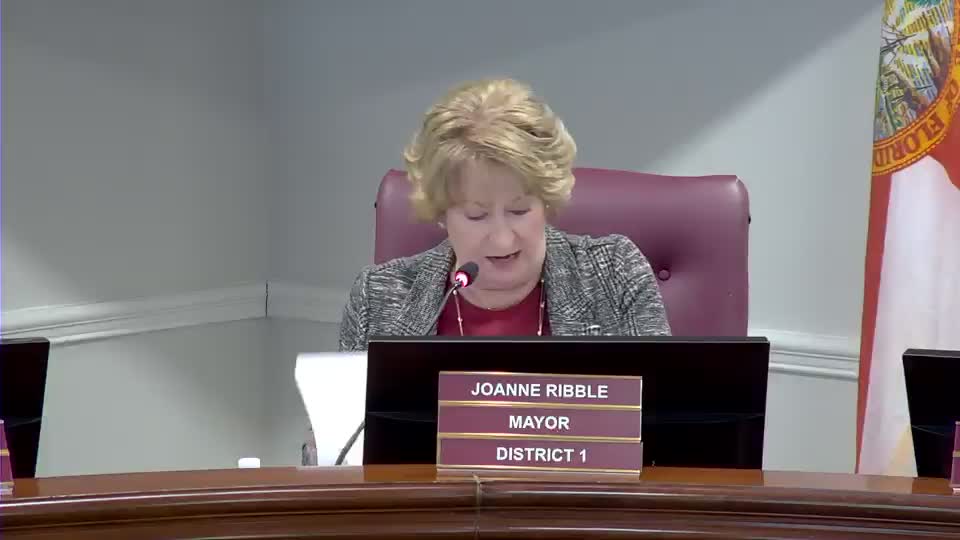
Estero council continues debate over perimeter‑landscape ordinance, sends staff back to redraft
Summary
After a lengthy debate over requiring perimeter landscape buffers and shortening development order durations, the council voted to continue the public hearing on Ordinance No. 2025‑17 to Feb. 4 so staff can revise language addressing triggers, phased projects and bond/waiver mechanics.
The Village Council on Jan. 21 voted to continue the public hearing on Ordinance No. 2025‑17, a proposed amendment to the village land‑development code that would create a new requirement for perimeter landscape buffers and shorten the default duration for development orders from five years to two.
Planning Director Mary Gibbs said the ordinance was drafted in response to recurring complaints about approved but undeveloped sites that become eyesores. Gibbs told the council the intent is to balance developers’ need for flexibility with the community’s expectation that vacant approved parcels not degrade neighborhood character. She added that state law (discussed in the hearing) may affect timing of enforceability and that extensions for natural disasters are consistent with state allowances.
Council members raised multiple concerns during the nearly two‑hour discussion: whether the buffer requirement should trigger only after land clearing or at approval; how the rule would work with phased development orders; whether the requirement would be too punitive for developers in a difficult market; and how the village could avoid requiring redundant safeguards (for example, bonding or perimeter planting) that would deter responsible builders. Vice Mayor Zulu and several members suggested edits that would trigger buffer requirements after "engaging in any land clearing, infrastructure installation or construction" rather than simply upon grant of a development order.
Councilors also pressed staff on the six‑month inactivity trigger in the draft and on practical definitions of "active construction" and "break in work," with the village attorney and management noting that staff can craft waivers or case‑by‑case determinations but that codifying a standard in the land‑development code makes enforcement uniform across projects.
Public comment from a Genova resident raised additional concerns about infrastructure, traffic and whether promised community improvements would still be delivered if a property were sold. After discussion, the council voted unanimously to continue the public hearing to Feb. 4 and directed staff to return with revised language that addresses the council's concerns and avoids the need to re‑advertise the ordinance title.