Baltimore committee reviews COMAR 10.63 revisions aimed at psychiatric rehabilitation program accountability
Loading...
Summary
The Baltimore City Public Health and Environment Committee heard from BHSB on proposed COMAR 10.63 regulation changes that would clarify local behavioral health authority roles, permit LBHAs to conduct pre-site visits, restrict PRP telehealth use, and extend an enrollment pause for certain Medicaid provider types through June 30, 2026.
Councilwoman Felicia Porter convened the Public Health and Environment Committee to review proposed revisions to COMAR 10.63 and their implications for psychiatric rehabilitation programs (PRPs) in Baltimore City. Adrienne, a representative of BHSB, briefed the committee on the draft regulations and implementation challenges.
Why it matters: The draft COMAR revisions aim to tighten provider accountability and quality standards across the public behavioral health system. Porter said the hearing was “an opportunity for us to examine the accessibility, the effectiveness, the regulatory oversight of PRP services,” emphasizing local concerns about service quality and oversight.
BHSB’s role and funding: Adrienne described BHSB as the city’s local behavioral health authority and said the organization administers “around $64,000,000 in funds for services that aren't reimbursable through the public behavior health system.” She said BHSB works with the Maryland Department of Health (MDH) to oversee PRPs and other public behavioral health services in Baltimore City.
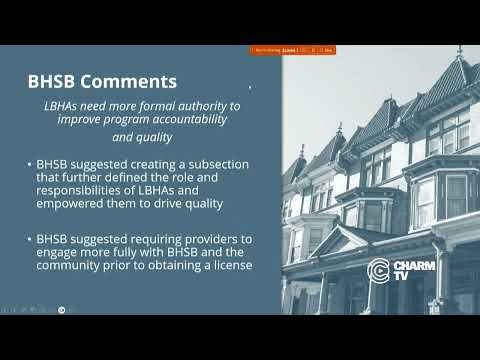
Accepted changes and local authority: Adrienne told the committee some of BHSB’s recommendations were incorporated into the draft, including language that allows local behavioral health authorities to conduct pre-site visits before issuing an agreement to cooperate. She said that change gives LBHAs “black and white” regulatory clarity to guide inspections and oversight, while clarifying that formal licensing remains the responsibility of MDH.
Telehealth limits and monitoring: The draft contains new telehealth restrictions for PRPs: group PRP services would not be allowed via telehealth and no more than 50% of individual PRP services could be provided remotely. Adrienne said BHSB supports those provisions to preserve in-person group care for people with severe mental illness. Porter and Adrienne discussed monitoring: compliance would rely on claims data from the public behavioral health system, but BHSB currently lacks routine access to a regular monthly claims feed following an administrative services organization (ASO) transition; Adrienne identified the current ASO as Carillon and said ad hoc data requests can be made for investigations but a systematic feed is not yet available.
Medicaid enrollment pause: Adrienne reported that Maryland has maintained a pause on enrollment for certain provider types, including PRPs, intensive outpatient programs and partial hospitalization, in Baltimore City. That pause has been extended through 06/30/2026 in Baltimore City; nine other jurisdictions have had the pause lifted.
Next steps and follow-up: Adrienne offered to provide follow-up detail on draft service-delivery requirements (for example, supportive employment measures) and on any outcome metrics BHA uses in its budgeting processes. Porter asked the committee to partner on outreach and technical assistance—using the council’s communications channels and provider-relations staff—to help providers understand and comply with final regulations. Adrienne encouraged community members to submit complaints as a tool for identifying problematic providers.
The committee concluded with Porter praising a separate city effort to list naloxone locations and noting she looks forward to the next hearing.