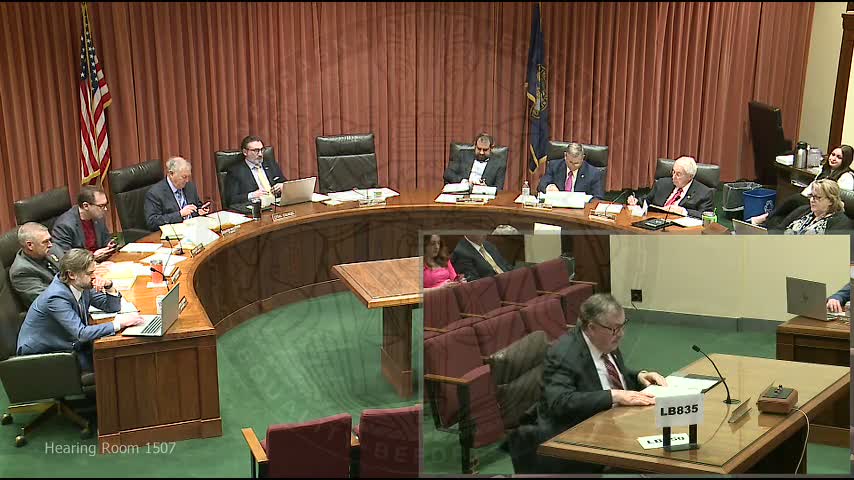
Bill to modernize Secretary of State filing and fee systems draws support from clerks, bankers
Summary
LB835 would update filing procedures and fee structures for the Secretary of State's office, eliminating obsolete fees, consolidating deposit accounts, and making certain small fees nonrefundable; proponents said upgrades already launched and the changes improve efficiency for UCC, EFS and tax-lien filings.
Senator Mike Jacobson introduced LB835 as a Secretary of State initiative to modernize filing and fee structures for records such as UCC financing statements and effective financing statements (EFS). Jacobson said the bill moves Nebraska away from paper-era procedures and toward digital data management.
Colleen Bylick, chief deputy and general counsel for the Secretary of State, told the committee the office launched a new filing and search system and that LB835 eliminates a number of small or outdated fees (for example, a $10 acknowledgment fee and a $30 company registration fee for master lien list access) and updates the cash-fund destination for certain collections. Bylick said some fees are being made nonrefundable because the administrative cost of refunds exceeds the amounts typically in question.
Committee members asked whether the changes would speed LLC processing times and how the fees were benchmarked. Bylick said their recent review used nearby states for comparison and cited a UCC revenue total of roughly $1.179 million in 2025 for filing, search and bulk services. Ryan McIntosh of the Nebraska Bankers Association testified in support, saying bankers expect marginal impacts and greater efficiency from the modernized system.
Bylick and McIntosh emphasized the move away from fixed paper-era caps (for example, removal of a $2,000 cap on batch image requests) to more flexible, volume-appropriate fees. The committee closed the record after proponent testimony and noted written submissions included one opponent and one neutral letter on the bill.
No amendment votes or formal committee actions were taken during the hearing.