Get AI Briefings, Transcripts & Alerts on Local & National Government Meetings — Forever.
House panel approves narrow fix to junk-fees law to allow certain RUBS utility allocations; tenants and advocates warn of enforcement gaps
Loading...
Summary
Lawmakers advanced House Bill 10-13, a technical clarification to last year’s 'junk fees' statute to allow ratio utility billing systems (RUBS) where individual submetering is infeasible, while tenant advocates and poverty-law counsel pressed for guardrails and criticized opaque billing practices; the committee approved the bill 10–3 and sent it to the Committee of the Whole.
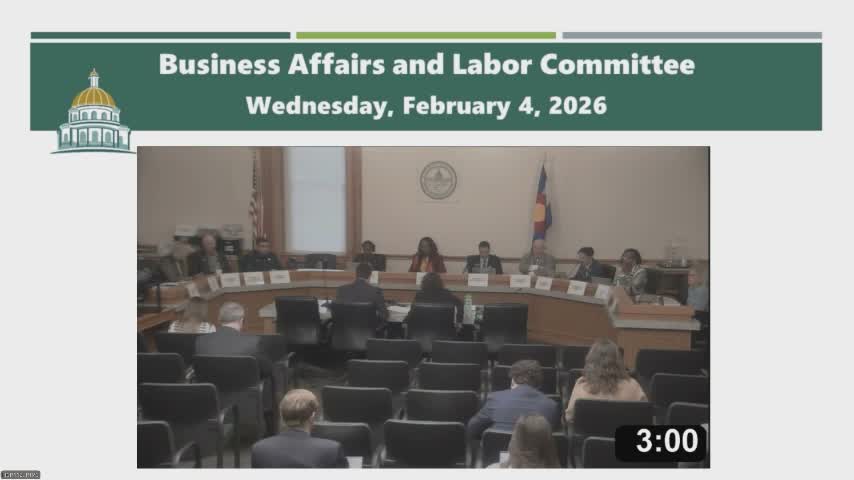
Sponsors told the House Business Affairs & Labor Committee that House Bill 10-13 is a limited, technical clarification intended to align the statute enacted last year (House Bill 25-1090) with legislative intent. "What this bill does is simply provide clarification that for properties that have multifamily units and do not have a direct meter to the unit, this system that has been in use… is allowable under the junk fees law," sponsor Representative Seroda said.
Opponents urged caution. Jack Reagan Bogan, deputy executive director at the Colorado Poverty Law Project, testified in an amend position that ratio utility billing systems can be unfair and unpredictable for low-income tenants, can obscure charges for common areas, and may remove tenants’ incentives to conserve. "Under a ratio utility billing system, tenants can be charged for utilities that they did not use at all," Reagan Bogan said.
Supporters, including Andrew Hamrick of the Colorado Apartment Association and Jeffrey Reister from the Department of Law, urged the clarification while describing safeguards. Hamrick said the statutory fix should be accepted only where four conditions are met: the aggregate billed amount to tenants does not exceed the property’s utility bill; a reservation or reduction for common-area use is made; the allocation formula is disclosed and agreed in the lease; and accounting or administrative charges remain within statutory fee caps. Reister said the Attorney General’s Office previously issued guidance and that codifying the approach provides certainty beyond the current administration.
Tenant advocates said they continue to receive complaints about how the junk-fees law has been implemented, including mid-lease addenda and apparent attempts to shift prohibited fees into other line items. Ada Altman of the Denver Metro Tenants Union said complaints have been widespread since Jan. 1 and urged rigorous enforcement and clearer tenant protections.
After discussion and assurances from sponsors about stakeholder engagement, the committee voted to advance House Bill 10-13 to the Committee of the Whole with a favorable recommendation. The roll call recorded a 10–3 vote in favor.