Get Full Government Meeting Transcripts, Videos, & Alerts Forever!
Get email alerts on the Budget Environmental Health topic
No spam. Unsubscribe anytime.
Story County supervisors review FY27 Environmental Health budget, flag extra well grant and vehicle needs
Summary
Supervisors reviewed the FY27 Environmental Health budget on Feb. 4, discussing an extra $50,000 groundwater grant, permit and radon-kit revenue shortfalls, a $10,000 request to outfit a second field vehicle, migration off CitizensServe, and anticipated higher mailing costs tied to notices of violation.
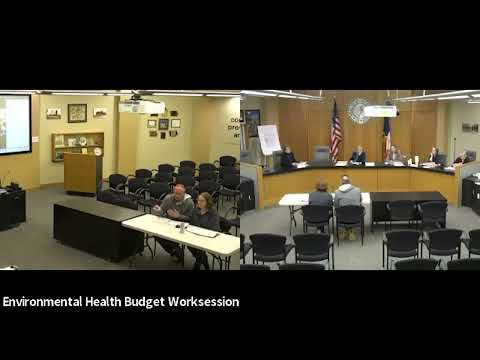
AMES, Iowa — Story County supervisors and Environmental Health staff reviewed the department’s proposed FY27 budget on Feb. 4, focusing on state grant revenue, permit and program fees, equipment and vehicle needs, and short-term data‑migration plans.
Supervisor Lisa Heddens opened the session saying the purpose was to examine the FY27 budget request for Environmental Health. Staff described a $45,000 annual award from the Groundwater Protection Fund and a separate $50,000 appropriation they received this year after they had “exhausted all our funds,” according to Laura Johnston, environmental health ("We get the 45 every year, and then the 50,000 we got was because we exhausted all our funds."). Matt Corey, environmental health, added that the $45,000 baseline for the current year has already been largely spent: “We’ve halfway through, we’ve already exhausted that 45,000.”
The department said that the additional $50,000 should be fully usable in the current fiscal year and that staff will reestimate expense projections to reflect the added funding. Supervisors and staff discussed how to present the reestimate; staff noted a projection exercise that would change the groundwater rehab line to reflect 75% pass-through calculations.
Revenue lines tied to state contracts were also clarified. Staff explained the septic pumper inspections are contracted through the Iowa Department of Natural Resources and described some receipts as pass-through; Environmental Health invoices inspected facilities directly for certain services such as aquatics inspections. The department expects septic and well permit counts to stay roughly the same and does not propose fee increases at this time, but supervisors requested any fee changes be placed on the next Board agenda for formal consideration.
Radon testing and outreach were another focus. Johnston said the department bought radon test kits at roughly $12.50 each, planned 60 kits at that cost in the draft budget, and sells kits to the public for $10 as part of promotional giveaways to encourage home testing. Johnston reported heavy demand in January: “We’ve gone through a 160 so far in January,” and staff cautioned that selling kits below cost during promotional periods will need to be reflected in expense estimates.
Operational needs drew repeated attention. Staff requested $10,000 to outfit (not purchase) a second county vehicle to enable simultaneous field inspections and reduce reliance on unmarked personal cars for enforcement work. "They can get one from the sheriff's department, but it's to outfit it," said a staff member about vehicle sourcing. Laura Johnston raised safety concerns about staff using personal vehicles on inspections: “I really don't like driving my personal car that's unmarked to people's properties ... It does not feel safe.” Supervisors indicated funding for outfitting and the potential impact on mileage and postage line items would be considered in the overall budget balance.
Staff warned that mailing and publication costs will likely increase because they expect to issue more notices of violation once the additional well‑program funds are spent. The department said it could handle shortfalls with a future budget amendment if needed.
Several administrative and IT items were discussed: subscriptions and GPS licensing (Catalyst on Demand), GIS services handled by the county IT department, and a per‑page cost to upload records to an online archival service (Arca Search). Staff outlined a plan to migrate permit and payment data off the CitizensServe platform before the vendor stops service; there was confusion about the cutoff date (participants referenced March 1 and March 14), and staff proposed downloading legacy data and offering a temporary paper or web form plus alternate payment options if necessary.
Staff also noted that three or four local ordinances — tanning, septic, and aquatic references to state code — will need updating to match recent state code changes; one supervisor suggested the current $1,620 line for ordinance publication may be sufficient but that increased mailing needs could still drive a request for a budget amendment.
No formal votes or policy decisions were taken at the session. Supervisors thanked staff for the review and identified follow‑up tasks: place any proposed fee schedule or ordinance changes on a Board agenda, reestimate groundwater expense lines to include the extra funding, and prepare for the CitizensServe migration and potential postage/notice budget amendment.
People quoted in this article are those who spoke during the Feb. 4 budget review: Supervisor Lisa Heddens; Supervisor Linda Merkin; Supervisor Latifa Fasil; Auditor Lucy Martin; Assistant Auditor Lisa Markley; Alyssa Wignall, director of internal operations and HR; Matt Corey, environmental health; Laura Johnston, environmental health; and Leanne Harter (first introduced in the meeting). The board session produced no formal motions or votes during the Environmental Health budget review.