Get Full Government Meeting Transcripts, Videos, & Alerts Forever!
Get email alerts on the Land Use Zoning topic
No spam. Unsubscribe anytime.
Committee splits on how far rezoning should reach in University Boulevard plan; staff backs CRN with overlay and compatibility rules
Summary
Council staff recommended a modified CRN (Commercial‑Residential Neighborhood) zone with a University Boulevard overlay to allow modest infill and pedestrian‑oriented development; committee members disagreed over whether rezoning should extend a block into neighborhoods and whether heights should be 45 or 50 feet, deferring final decisions to upcoming meetings.
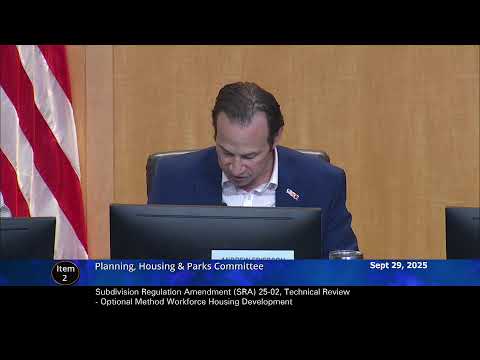
Council planning staff told the Planning, Housing and Parks Committee on Sept. 29 that the University Boulevard quarter plan recommends a modified Commercial‑Residential Neighborhood (CRN) zone combined with a University Boulevard (UB) overlay to support modest infill near proposed BRT station areas while protecting smaller lots and civic uses.
The staff presentation described the overlay's compatibility features: for net sites under 15,000 square feet, development would be held to duplex standards (reduced lot coverage to 35%, 6‑foot side yards, 5‑foot front setbacks) "to get at the feedback that we were hearing from the community," planning staff said. Jessica McVerry, describing overlay protections, said those measures are intended "to make sure that we have some level of compatibility for those smaller scale developments."
Planning proposed CRN with a residential FAR of 1 and a 50‑foot height cap along the corridor, but council staff recommended a technical change: lowering height for specific sites (Berkeley Court/Westchester) to 45 feet. Planning staff and several council members emphasized that where CRN abuts an R‑zone, the ordinance requires a step‑down to lower heights (35 feet) and angular plane protections.
Committee members disagreed on how deep the rezoning should go. Some members, citing recent adoption of ZTA 2502 (a workforce housing zoning text amendment), urged consistency and limited application to properties fronting University Boulevard; others argued the master plan process should recommend more comprehensive rezoning to meet local housing targets. Councilmember Mink said she preferred not to adopt rezoning for detached single‑family properties in her district and to rely instead on other approaches to meet infrastructure needs.
The committee conducted a straw vote on staff recommendations, agreeing on several technical items and adopting a 45‑foot amendment for the Berkeley Court/Westchester site, but leaving the broader question—how far CRN should extend into neighborhoods—for additional neighborhood‑by‑neighborhood review at upcoming work sessions.
What happens next: Planning will return with detailed maps and neighborhood‑level recommendations at the Oct. 20 meeting. The plan and any SMA (sectional map amendment) would be the vehicle to implement zoning changes if the committee moves forward.