Get Full Government Meeting Transcripts, Videos, & Alerts Forever!
Get email alerts on the Emergency Communications topic
No spam. Unsubscribe anytime.
Montgomery County 911 director outlines path to full staffing, AI trials and shift changes to reduce wait times
Summary
Director Jen Reedy told the Public Safety Committee the Emergency Communications Center has cut vacancies from a prior high toward about 14%, has 25 trainees and expects to be fully staffed by July 2026 with expanded classes and AI pilot projects to triage non‑emergency calls.
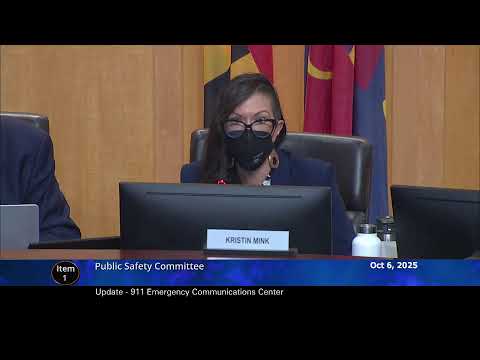
Montgomery County’s Emergency Communications Center (ECC) director told the County Council on Oct. 6 that the center has made measurable hiring progress but still needs space, staffing and new tools to reduce call wait times and sustain operations.
Director Jen Reedy said the ECC currently has 25 trainees in various stages of training and around 19 vacancies against an authorized staffing level of 171. She reported a December academy class that will be operational around March and a plan for additional classes; if hiring continues at the current pace and classes of 12 recur, the ECC expects to reach full staffing (up to 198 authorized positions) by July 2026.
Reedy outlined three near‑term strategies to reduce waits: adjust shift schedules to match peak call volumes (adding overlapping 10‑hour day shifts to concentrate staff from mid‑day into evening hours starting with a schedule change effective in February), pilot AI‑driven call‑screening tools funded by the Maryland 911 Board to route or answer many non‑emergency calls, and continue recruitment and training to fill vacancies (training spans roughly 12–18 months).
Council staff and members noted the ECC’s historical high vacancy rate — up to 41% at one point — and said that while vacancies have declined to roughly 14%, the county had abolished 25 ECC positions earlier as a budget saving measure. Reedy and staff urged attention to the ECC’s physical plant: the primary and alternate centers are intended to function identically, but neither site currently offers optimal training space or redundancy for operations; an alternate site is listed in the county CIP under facilities planning.
Members pressed Reedy about workforce supports and operational stressors. The director stressed the importance of mental‑health resources, noting the ECC has a dedicated social worker and cited the need for downtime after critical calls and decompression space. Panelists also described early work to manage frequent callers ("frequent flyers") by developing memoranda of understanding with 988/crisis services and the Scribe Center to redirect non‑emergency behavioral health calls while establishing transfer and liability protocols.
On recruitment, Reedy said a new hiring platform and a $5,000 signing bonus have broadened applicant pools, including candidates from federal positions and other public‑safety backgrounds. Council members expressed support for continued hiring and retention measures. The committee closed the update with a thanks to ECC staff and no formal action taken.