Get Full Government Meeting Transcripts, Videos, & Alerts Forever!
Get email alerts on the Transportation Bus Lanes topic
No spam. Unsubscribe anytime.
Committee accepts plan boundary change; DOT presents bus‑lane pilot data and says lane will remain
Summary
The Planning, Housing and Parks Committee accepted a boundary revision for the University Boulevard quarter plan and heard MCDOT present pilot findings showing a 7% bus run‑time reduction, about 1% non‑transit intrusion, and MDOT’s May 2025 decision to make the red bus lane permanent; BRT station design remains unfunded.
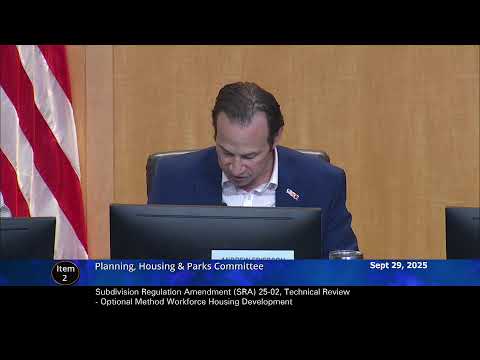
The Montgomery County Planning, Housing and Parks Committee on Sept. 29 accepted a staff‑recommended revision to the University Boulevard quarter plan boundary and heard a transportation briefing from the Montgomery County Department of Transportation (MCDOT) on existing and planned transit improvements along the corridor.
MCDOT project manager Corey Pitts told the committee that the bus‑lane pilot, launched in February 2024, produced measurable benefits for transit riders. "We did see a 7% reduction in bus travel or run time," Pitts said, and staff observed "about 1% of non transit vehicles that would sneak into the lane," a low intrusion rate given the pilot relied only on paint and signage.
The pilot corridor carries the Metrobus M12 route, which Pitts said serves almost 11,000 weekday riders as of May, and MCDOT reported that the Maryland Department of Transportation agreed in May 2025 to make the pilot lane permanent. Pitts emphasized that while the county supports bus mobility and the existing red curb‑lane, "implementation of any new bus lanes . . . would require further study," and that no county funding has yet been programmed for design of a future BRT facility along University Boulevard.
State Highway Administration District 3 engineer Derek Gunn told the committee that SHA "supports these efforts" to improve multimodal accessibility but stressed projects must be locally led and coordinated. Committee members raised equity and safety concerns: Councilmember Fanny Gonzalez highlighted that the M12 ridership is disproportionately nonwhite, saying "89% of them are people of color," and argued rapid, reliable bus service is critical for workers who rely on transit.
Committee members also pressed MCDOT and SHA on trade‑offs between bus rider time savings and impacts on automobile travel, signal‑timing mitigations, and outreach. MCDOT said there is no single numeric threshold but that the agency weighs people‑throughput, reliability, and safety; staff cited examples where bus‑priority lanes moved many more people during service disruptions.
Next steps: transportation recommendations in the University Boulevard plan will return to committee on Oct. 20 (with additional sessions planned) for further review of station areas, potential extensions of bus lanes, and more detailed traffic analysis. MCDOT said it will continue monitoring lane performance and explore enforcement tools while county and state partners coordinate on signal timing and pedestrian safety work in the corridor.
Sources: MCDOT presentation and committee Q&A; state SHA briefing.