Get Full Government Meeting Transcripts, Videos, & Alerts Forever!
Get email alerts on the Zoning Native Plants topic
No spam. Unsubscribe anytime.
Montgomery County committee weighs 50% native-plant rule amid concerns about play space and sod growers
Summary
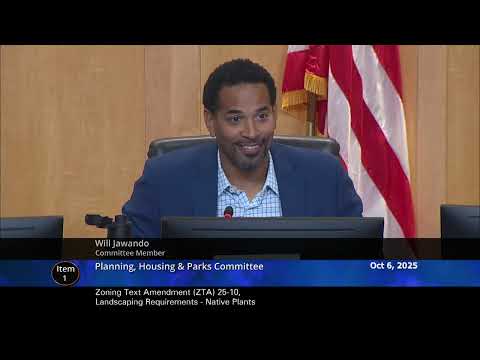
The Planning, Housing and Parks Committee continued debate on ZTA 25-10, a zoning text amendment that would require 50% native species in certain landscaping plans; members pressed staff on measurement methods, inspection timing and impacts on townhome/multifamily recreational turf and sod farms, and deferred final action pending further work.
Council staff and members spent much of the committee’s October 6 work session debating how and where a proposed zoning text amendment, ZTA 25-10, would require native plants in Montgomery County landscaping plans.
Sponsor (speaker 2) framed the measure as part of a Native Plant Protection Act package intended “to sustain our biodiversity, building climate resilient landscapes, and also supporting pollinators.” Staff said the ZTA would change the code’s existing “preferred” native-plant language to “required” and would apply to landscaping plans that are part of development applications, parking-lot landscaping and screening requirements — not to by-right single-family homes or projects approved before the rule’s effective date.
The committee’s central debates focused on three questions: which projects the rule would trigger, how to measure the 50% threshold, and whether the requirement would strip usable recreational turf from townhome and multifamily developments.
Staff presented four measurement options: (A) by area (square footage), (B) by category (50% within each plant category such as trees, shrubs, grasses and perennials), (C) by plant-count/list (50% of the plants listed on the approved plant schedule), and (D) by mass/size (weighting shrubs, trees and groundcover). Planning staff said the planning board favored option B to force diversity across categories; some landscape contractors preferred option C.
Robert Cronenberg, a planning staff member, said the site-plan process already includes a plant schedule and proposed adding a native/non-native flag to that schedule to make enforcement easier: “we need another column in that plant schedule to say native, non native, so that it makes it easier to track for us.”
Council members raised how the rule would affect small common green spaces used for play. Council member Balcom, referencing townhome village greens, argued the change could deprive children of usable turf: “It is the only green space for kids to play.” She and Council member Lukey proposed an amendment to exclude existing recreational turf (referred to in discussion as an exemption for sod) from the 50% calculation.
Staff and DPS (Department of Permitting Services) clarified enforcement and the timing of inspections. DPS deputy director Ihsan Motaizi described the existing process: the approved site plan shows plant species and spacing, DPS does a final inspection after installation, and the county holds a surety bond (50% released on initial completion and the rest after a one-year reinspection). Motaizi said replacements are required for plant material that dies during the bond period, and inspections verify the site plan implementation rather than recalculating percentages based on later growth or changes.
Opponents from the agricultural and sod-growing community had filed comments noting that commonly used turf and sod species are not native and that local growers could be hurt if the rule is applied without exemptions or practical measurement standards. Supporters cited climate and biodiversity benefits and asked for a clear, enforceable standard.
Committee members generally agreed that more work was needed before a vote. Several members pressed staff to draft clearer language tying enforcement to the final approved landscaping plan and to bring back detailed recommendations on measurement methodology, potential exemptions for recreational turf, and information about native-plant supply in the local market.
The committee did not take a final vote on ZTA 25-10 and left the item for further work and potential amendments before full-council consideration.