Get Full Government Meeting Transcripts, Videos, & Alerts Forever!
Get email alerts on the Enrollment Trends topic
No spam. Unsubscribe anytime.
Albert Lea district projects continued enrollment decline; task force weighing school consolidation and program expansions
Summary
At a Feb. 2 study session, district staff reported declining enrollment and ADM, citing falling birth rates, migration and open‑enrollment shifts; staff outlined projections, potential consolidation of elementary schools, and program responses including preschool expansion and boosting online academy capacity.
Paul Irvine, who presented the district's Feb. 2 study-session enrollment update, told the Albert Lea Public School District board that the district's K–12 seat count was 2,940 as of Jan. 26 and that the district is tracking an ongoing decline in average daily membership (ADM).
"So right now as of January 26, we had 2,940 students in seats in our school district," Irvine said during the presentation, noting that seat counts and ADM are different measures used for staffing and state funding.
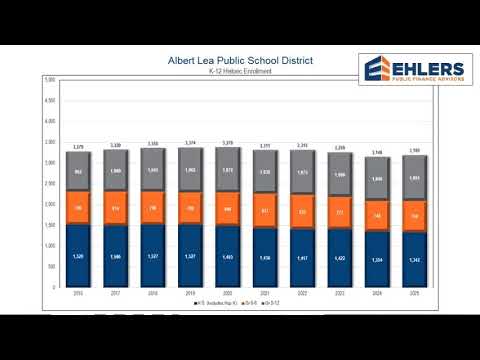
The presentation outlined three analytical lenses: historical enrollment, current demographics and projections. District charts from financial advisers Ehlers and the MARS (Minnesota Automated Reporting Student System) reports show a steady enrollment increase through about 2020 followed by a marked decline since then, concentrated largely in elementary grades. The district's projection method produced an end‑of‑year ADM estimate of about 3,056, roughly in line with Ehlers' model near 3,086, but staff warned updated fall numbers can materially reduce multi‑year projections.
Why it matters: ADM—distinct from head count—drives adjusted pupil units (APU) and much state funding. The district said falling ADM will require staffing and budget adjustments and that it must plan for fewer students per grade level over the next several years.
Drivers and patterns identified
- Natural migration and falling birth rates: District and Ehlers charts show fewer incoming kindergarteners relative to exiting seniors, a trend that compounds revenue loss because seniors generate a higher APU weighting than kindergarteners.
- Grade‑to‑grade migration: A five‑year migration analysis showed a net loss from kindergarten to first grade (about 3.77 ADM on the five‑year average) and a notable drop from 10th to 11th grade tied in part to 15‑day drops (students who leave before formal reporting). The district also flagged increases in some grade transitions, such as 5→6 and 11→12, as outliers worth further study.
- Open enrollment and alternative options: Staff reported 41 students open‑enrolled into Albert Lea so far this year and 52 open‑enrolled out. Many families who leave cited online schooling or homeschool options; those entering often cited family/work connections and location.
- Demographics and needs: Over the last decade the district's share of Asian and Hispanic/Latino students rose while the white share fell; free and reduced‑price lunch participation is near 58% and English learner counts are up. A new housing questionnaire per MDE guidance also increased identification of McKinney‑Vento eligible (homeless) students.
Operational and program responses discussed
Board members and administrators focused on three buckets of response: retain and recruit students, right‑size facilities and staffing, and adapt programming to community needs.
- Recruitment and marketing: Administrators recommended more targeted outreach and social‑media marketing to tell the district's story, highlight literacy and math initiatives and publicize CTE and apprenticeship pathways.
- Early childhood and preschool pipeline: Staff noted 67 kindergarteners already registered with additional registration sessions planned; the district identified roughly 103 potential kindergarteners currently in district preschool who have not yet registered. Presenters said expanding voluntary preschool seats and preschool/daycare capacity could improve retention into kindergarten.
- Online academy capacity: The district's online academy is currently at or near capacity; board members and staff discussed increasing staffing for the online program to reduce loss to external online providers or PSEO online offerings.
- Wraparound and after‑school care: Partnerships with the local Y and options to license or expand after‑school care were discussed as family supports that could help retain students.
Facilities and finance implications
Using K–5 projection scenarios, staff noted that consolidating from four elementary buildings to three could yield roughly 419 students per building under one projection, but cautioned that transportation costs, statutory distance limits and special‑education placements complicate any boundary or building change. Staff warned that declining ADM will reduce general‑fund revenue, even as some restricted‑fund sources (for example EL funding) may increase; they emphasized the need to apply restricted dollars strategically.
Next steps
District staff said they will continue task‑force work on facilities and program recommendations, pursue additional fact‑finding on open‑enrollment drivers, and present a revised budget at the board's Feb. 17 meeting that will include at least three years of financial projections and reduction targets. A final adopted budget is scheduled for June.
Ending
Board members praised the level of data and the task‑force process; staff will return with more detailed recommendations for recruitment, program adjustments and fiscal options as revised budget numbers are prepared.