CSB: Failures in hazard recognition, dust control and leadership led to 2017 Didion Milling explosions; NFPA updated guidance, OSHA still urged to act

U.S. Chemical Safety Board safety briefing · February 4, 2026

Get AI-powered insights, summaries, and transcripts

Subscribe
AI-Generated Content: All content on this page was generated by AI to highlight key points from the meeting. For complete details and context, we recommend watching the full video. so we can fix them.

Summary

A U.S. Chemical Safety Board investigation found that a May 31, 2017 combustible‑dust explosion at Didion Milling in Cambria, Wisconsin, was driven by poor hazard recognition, inadequate fugitive dust management, missing dust hazard analyses and weak safety leadership; the CSB recommended NFPA update guidance (resulting in NFPA 660) and again urged OSHA to adopt a comprehensive combustible‑dust standard.

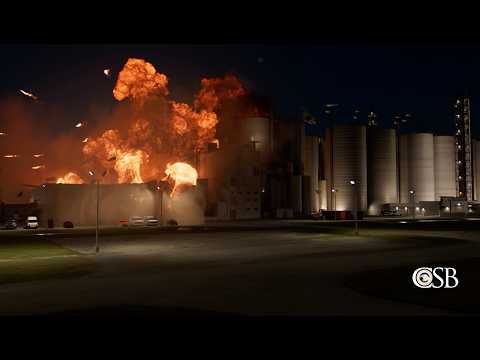
On May 31, 2017, a combustible‑dust incident at Didion Milling’s dry corn mill in Cambria, Wisconsin, escalated from a smoldering nest inside grinding equipment to a series of internal and secondary explosions that destroyed the facility and killed five workers, according to a U.S. Chemical Safety Board report presented in the transcript.

The CSB investigation identified 13 safety issues that converged to cause the catastrophe. Key findings included poor process hazard recognition (materials and some finished products were of a particle size that qualified as combustible dust), a lack of dust hazard analyses (DHAs), inadequate management of fugitive dust and deficient process safety leadership that had normalized smoldering events and minor upsets over several years.

"These factors led to a catastrophic incident that could have been prevented," said Speaker 2 (Unidentified Speaker) in the CSB briefing, summarizing the board’s conclusion that multiple preventable safety failures contributed to the disaster.

The report describes the incident sequence: shortly after 10:30 p.m., employees noticed smoke or an unusual smell, searched for the source on the first floor of B Mill, then an initial explosion occurred inside process equipment. A pressure wave dispersed accumulated dust inside interconnected piping, a flame front reached an external dry grit filter that overpressurized and released a fireball, and secondary explosions fueled by fugitive dust outside process equipment caused multiple building collapses and extensive facility destruction.

The CSB singled out several specific deficiencies. Didion’s sanitation program and housekeeping practices were based on food‑safety standards meant to control pathogens and contaminants, not workplace process‑safety standards for combustible dust. As a result, hidden overhead and limited‑access areas were not inspected or cleaned to control fugitive dust accumulations. The CSB also found that interconnecting numerous pieces of equipment to the same dust collection system allowed a flame front to propagate throughout the process.

On the regulatory front, the CSB noted that Didion was covered by OSHA’s grain handling facility standard, but that standard did not require safety‑management system elements such as incident investigations, management of change, and DHAs. The CSB reiterated a longstanding recommendation, first made in 2006, that OSHA promulgate an overarching combustible‑dust standard for general industry.

The transcript states the CSB recommended that the National Fire Protection Association update its guidance to remove equipment exemptions and require DHAs for all processes; in response, NFPA published a comprehensive combustible‑dust standard (cited in the transcript as NFPA 660). The CSB again urged OSHA to adopt a comprehensive standard; the transcript records that OSHA had not yet acted on the CSB’s repeated recommendations.

Casualty reporting in the transcript contains differing statements: an early segment reports five fatalities and 14 injured, while a later segment states 19 employees were working that night and that five were fatally injured; the transcript does not reconcile those two numbers. The article therefore reports the consistent fact of five fatalities and notes the transcript’s inconsistent reporting on the total injured count.

The CSB concluded with safety guidance: facilities that handle combustible dust should perform DHAs, apply appropriate engineering controls, use housekeeping practices designed to control fugitive dust accumulations, limit interconnections that permit flame propagation, and strengthen process safety leadership and culture. The CSB also repeated its policy recommendation that OSHA adopt a comprehensive combustible‑dust standard for general industry.

The CSB video closed by directing viewers to csb.gov for the full report and resources.