Get Full Government Meeting Transcripts, Videos, & Alerts Forever!
Get email alerts on the Contracts And Grants topic
No spam. Unsubscribe anytime.
Tuscaloosa City approves series of infrastructure contracts, change orders and a $400,000 recycling grant
Summary
The Tuscaloosa City meeting approved multiple contract amendments and change orders — covering bridge and road work, sewer rehabilitation, exhibit fabrication, and facility repairs — and authorized a cooperative recycling grant application worth up to $400,000 with no city match; specific vote tallies were not specified in the transcript.
Speaker 1 opened the meeting and the council moved quickly through a slate of infrastructure and procurement items, approving contract amendments, change orders and a grant authorization affecting roads, sewer, bridge and city facilities.
The meeting approved a $120,410 amendment to extend McGiffords Engineering Services from design into the bid and construction phase of the Cypress Creek project, described by Speaker 3 as part of the “NOAA 2 program”: “This is a contract amendment for a 120,000 a $120,410 to extend McGiffords Engineering Services into the bid and construction phase of the Cypress Creek project,” Speaker 3 said. The item was approved by voice vote.
Council members also approved a $15,012 amendment with Duncan Coker to add engineering for resurfacing bridge ramps tied to the Jack Warner Parkway (297) intersection improvements after a scope change. Speaker 3 said resurfacing while traffic control is already in place made the work “a good proposal.”
The body approved a service agreement with Kansas City Southern Railway to review engineering plans for the Stillman Boulevard bridge replacement, with Speaker 5 explaining the roughly $17,000 fee covers the railroad’s plan review to ensure the bridge meets the railroad’s height and width standards. Speaker 6 noted the process mirrors prior railroad review fees paid on earlier projects.
On sewer work, the council approved change order No. 1 for the Garner Road Sewer Project, adding $424,666.46 to replace seven manholes that were found to be beyond repair and extending the contract schedule by 150 days; project staff said funding exists in the project account and referenced 2025 bond funding as the source.
Other approvals included a $51,966.36 deduct for the McWright Ferry Road project (returns to the February bond issuance pending final closeout accounting), a $10,700 minor-works contract with Greenacres Landscaping LLC to restore driveways and landscaping on Lake Vista Drive after a water-line repair, and smaller facility and maintenance contracts — including a $2,827 repair at the Fletcher wastewater plant and about $7,400 to install a washer/dryer setup in a new city warehouse.
The council authorized the mayor to execute a cooperative recycling grant agreement among the city, the county, PERA, Shelton and the UA and accepted a recycling grant opportunity of up to $400,000 with no city match. Speaker 14 noted recent awards were in a similar range (Speaker 10 said the city received about $423,000 last year). Speaker 14 said partners apply together and allocations are made after the funding is awarded.
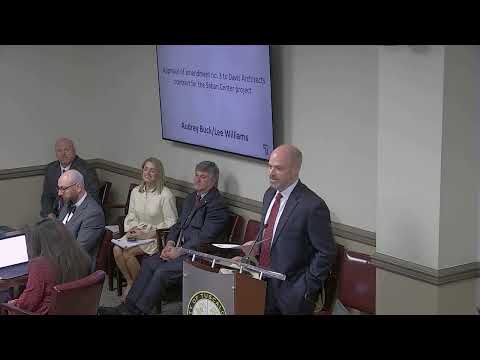
The meeting also approved an IT/automation change order for the planning department’s Blueprints application ($1,260) to export files to a local repository weekly, and a pair of exhibit-related contracts reallocating exhibit fabrication scope and adding $2,000,008.69 to a contract with a firm identified in the record as “49 degrees,” which staff said does not change overall budgeted spending but redistributes work among providers. Later, Amendment No. 3 to Davis Architects’ contract was approved for $419,888.50 to redesign spaces tied to moving the Sabin exhibit; speakers said donor funding will cover the additional design cost and that donors were briefed on the potential change last fall.
Votes at a glance (as recorded in the transcript): all listed agenda items were moved, seconded and approved by voice vote. The transcript consistently records motions and verbal “aye” responses but does not include full roll-call tallies for each item; where explicit individual votes were recorded, the article reflects the attributed speaker’s recorded response.
The presiding speaker asked for other business near the close of the provided transcript; the record ends mid-question and does not capture a formal adjournment.
What happens next: Most items are delivery- or construction-focused (design-to-bid transitions, change orders and vendor agreements). Staff indicated follow-up steps for final project closeouts, grant application submission and implementation scheduling (for example, exhibit installation work slated to begin January 2027).