Get Full Government Meeting Transcripts, Videos, & Alerts Forever!
Get email alerts on the School Facilities topic
No spam. Unsubscribe anytime.
Mahomet-Seymour board hears $64M–$150M scenarios to address overcrowded junior high; staff asked to return cost options
Summary
At a study session the Mahomet-Seymour CUSD 3 board heard detailed estimates for repairing and expanding the junior high, including a $64 million addition option that could be bonded without a referendum and an $81 million estimate to build a new junior high; board asked staff and architect to return refined scenarios and tax-impact calculations.
Mahomet-Seymour CUSD 3 board members spent the study session reviewing facility needs at the district junior high and discussing financing scenarios that range from a $64 million addition to an $81 million new-build and larger referendum packages up to $150 million.
An unnamed district presenter said the junior high, built around 1960, is overcrowded and reports 805 students in a building with a non-PORTABLE capacity of 615. The presenter identified aging mechanical, electrical and plumbing systems, water infiltration on the west side and asbestos in places, and said those conditions and space constraints are driving the district to consider sizeable capital work. "We know that the building is overcrowded," the presenter said, and referred to a BLDD estimate of about "$20,000,000" to upgrade whole-building systems.
Board members and the district's financial advisor laid out several financing pathways. The presenter explained that Illinois law limits bonding without a referendum to about 13.8% of the district’s EAV (equalized assessed value), which the district estimated as roughly $80 million in available capacity under that cap. The board discussed three principal options: (1) use available bonded capacity (example: $64 million) timed to retire existing debt so the tax rate would remain largely level; (2) issue a larger package that would require a referendum; or (3) pursue combinations of bond types (health/life/safety, working cash, alternate revenue) and a referendum to achieve a larger new-build package.
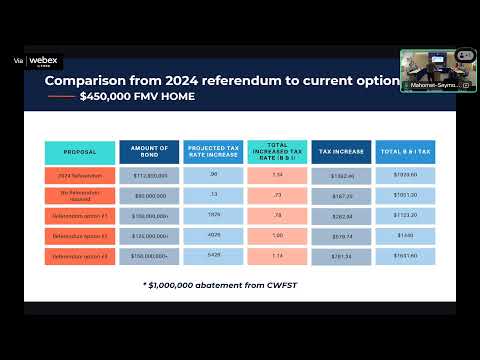
The presenter gave homeowner-impact examples drawn from the district model. Using a $450,000 market-value house (roughly $144,000 EAV after homestead exemption), scenarios shown in the presentation ranged from an annual increase of about $122 for an $80 million package to a $263 annual increase under a $100 million referendum scenario; the presenter emphasized the district used conservative growth assumptions (3% per year) when modeling future EAV.
Architectural scope and cost estimates were also discussed. The district reported that a $64 million package could provide about 72,000 square feet of addition and renovation (roughly freeing up space and removing portables), while building a new junior high on district-owned land was estimated at about $81 million at $575 per square foot for roughly 1,000 students. Lincoln Trail needs (classroom space, an additional gym and special-education rooms) were estimated separately at about $30 million. Board members noted that the $81 million figure covered building costs only and did not include relocating soccer fields or other athletic-site work.
Representatives from the underwriting/finance side recommended issuing bonds in multiple tranches to avoid holding idle cash (arbitrage rules) and to limit interest exposure, and said the municipal market is thinner for very long-term paper (e.g., 30-year issues). The underwriter advised conservative interest-rate assumptions for planning and noted the district and underwriter would time sales to market conditions.
After extended discussion about design-level choices (precast vs. masonry, finishes and fixtures) and how those choices change per-square-foot costs, the board asked staff and the architect to produce a set of concrete, costed options. Specifically, the board requested modeling for what $64 million would deliver; what $80 million would deliver; and the estimated cost to build new and renovate existing facilities (i.e., a build-new-plus-renovate scenario). The presenter also agreed to provide additional homeowner-impact breakdowns and work with Kevin Hyde (financial advisor) to check calculations.
The meeting closed the open session agenda by directing staff to return with more detailed scenarios and design-level options to support community engagement and potential referendum planning. No referendum was scheduled; the board did not take a public vote on any bond issuance during the open portion of the meeting. The board then moved into a closed session on personnel, student matters and bargaining.
Sources: Presentation and Q&A during the Mahomet-Seymour CUSD 3 study session (see district presentation numbers and Q&A; board requested additional architect and financial scenarios).