Get Full Government Meeting Transcripts, Videos, & Alerts Forever!
Get email alerts on the Parks Maintenance topic
No spam. Unsubscribe anytime.
Augusta commission votes to create standalone vegetation and landscaping department
Summary
After extended debate over staffing, contracts and budget, the Augusta‑Richmond County Commission voted to consolidate grass‑cutting and grounds functions into a new standalone vegetation and landscaping department, adopting the option staff described as a phased consolidation of crews and contracts.
The Augusta‑Richmond County Commission voted Feb. 3 to create a new standalone vegetation and landscaping department, moving crews and contracts now spread across multiple departments into a single unit charged with mowing, median and median maintenance, tree management and cemetery upkeep.
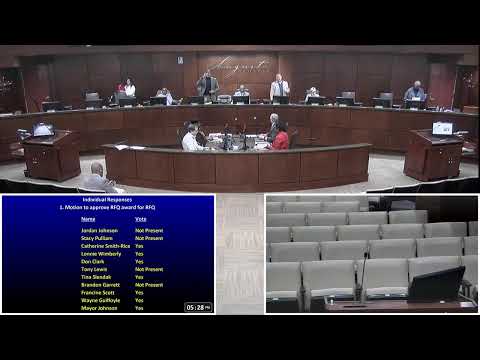
The motion, made by Commissioner Catherine Smith Rice and seconded by Commissioner Don Clark, passed after a roll‑call vote following several hours of discussion about cost, accountability and timing. Mayor Johnson and several commissioners urged a quick decision ahead of the grass‑cutting season, while others pushed for caution on long‑term sustainability and recommended a phased build‑out.
Why it matters: City staff told commissioners the city maintains more than 1,000 centerline miles of roadway, 168 detention ponds, 49 parks and 21 non‑park facilities, plus three city cemeteries and five private cemeteries, using a mix of 41 full‑time frontline employees, part‑time staff, RCCI crews and 18 contracts. Administrator Allen said the 2026 budget includes $800,000 in additional funding to support vegetation management: $450,000 for continued median contracts and $350,000 as start‑up funds for operational changes; the administration also set aside $100,000 for cemetery maintenance in the first year.
Debate: Supporters said a consolidated department would centralize accountability and allow more flexible crew assignments. Commissioner Catherine Smith Rice moved the measure, saying the current multi‑department structure is confusing for residents and inefficient. Opponents urged a more cautious approach: Commissioner Jordan Johnson questioned whether the city had a reliable multi‑year funding plan for operating and facility costs; Commissioner Lonnie Wimberley suggested an independent organizational review before standing up a new department to avoid repeating unsuccessful past reorganizations.
Staff response and implementation: Administrator Allen said the new department would be built by transferring existing positions that primarily perform vegetation duties; staff would also evaluate rebidding some contracts, consider converting certain RCCI (corrections) details to civilian positions and explore available county facilities for warehousing and a prefab operations building (a one‑time capital cost projected at roughly $400,000 in the presentation). Dr. Malik, representing engineering, told commissioners the positions proposed to move are predominantly assigned to mowing and vegetation work but also provide incidental storm response when needed.
Vote and next steps: Clerk recorded a roll‑call after a call for the question; the clerk announced the motion carried. Staff were directed to proceed with implementation planning, return with a staffing and budget detail and draft necessary memoranda of understanding (MOU) for any adopted parks or partner agreements. The commission’s action sets the administration to begin work on consolidation, contract rebidding and site planning for operational space.
Quote: "This current structure…is not working out," Commissioner Catherine Smith Rice said when she introduced the motion. Administrator Allen said, "I believe either approach could work and will yield good results for Augusta," while Dr. Malik cautioned that resource levels — not only structure — determine deliverability.
What comes next: Staff will present the implementation plan, expected costs and a timeline to the commission. The adopted approach is intended to start moving services into a single accountable work unit for the 2026 season; commissioners asked for clear milestones and periodic updates.