Get Full Government Meeting Transcripts, Videos, & Alerts Forever!
Get email alerts on the Cybersecurity topic
No spam. Unsubscribe anytime.
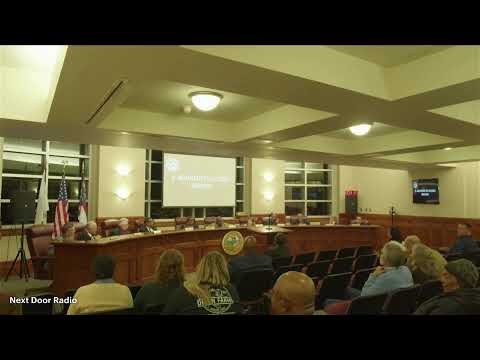
Oxford approves $2.25 million cybersecurity grant package and raises procurement questions
Summary
The Oxford Board of Commissioners approved a North Carolina cybersecurity grant to strengthen municipal defenses, covering advanced EDR, 24/7 monitoring, MFA and training; commissioners asked about sole-source procurement, match funding from fund balance, contract length (two years) and annual city costs.
Oxford officials approved a budget appropriation on Nov. 12 to accept a state cybersecurity grant intended to upgrade the city’s digital defenses and monitoring.
Patrick Newcomb, the presenter, said the grant would provide layered protections including advanced endpoint detection and response (EDR), a 24/7 security operations center, managed firewalls, vulnerability scanning, secure remote access/zero-trust measures, multi-factor authentication and email protections (DKIM/DMARC, anti-phishing and link scanning). Newcomb illustrated threats with local examples—businesses and nonprofits in the region had lost sums ranging from thousands to hundreds of thousands of dollars to fraud and impersonation attacks—and said the grant would "severely upgrade" Oxford's cybersecurity posture.
Staff told the board the city received a North Carolina Department of Public Safety Emergency Management state and local cybersecurity grant awarded Oct. 29, 2025, recorded in the meeting transcript as approximately $2,249,913 with a local match requirement discussed around $107,000 (transcript formatting unclear). The award must be spent by Feb. 28, 2028. Newcomb estimated implementation and onboarding would take about 30 to 60 days and said the grant was calculated to cover services for an estimated 130 employees; ongoing annual costs would rise or fall with any change in employee count.
Several commissioners asked procurement and budget questions before the vote: whether the city had obtained multiple bids or could require them, whether awarding the work to the presenting firm would constitute a sole-source arrangement, whether selecting another vendor would jeopardize the grant, and how the match would affect the city's fund balance. Staff responded that the grant was already awarded and that using another vendor would not cause the city to lose the grant, while explaining the presenting firm had helped prepare the application and had prior relationship with the city. Commissioners also clarified that the city would not be required to pay the whole match in one year; staff said the match equated to roughly $53,000 annually under the city's interpretation.
After discussion, the board moved, seconded and voted to approve the appropriation; the motion carried (voice vote recorded as 'Aye').
The board also discussed future steps: staff said they intend to monitor the implementation, review performance at the end of the grant period, and consider competitive procurement for future services when feasible.