Get Full Government Meeting Transcripts, Videos, & Alerts Forever!
Get email alerts on the Transportation Safety topic
No spam. Unsubscribe anytime.
Lake Bluff residents urge board to address wrong-way traffic at Oak and East Scranton
Summary
Residents told the Lake Bluff Village Board they regularly see vehicles traveling the wrong way on Oak Avenue and that sight-line issues at the Oak/Scranton intersection create near-misses; staff said planned bump-outs will shorten pedestrian crossing time but there are currently no plans to add stop signs and the village will route formal requests through its traffic-control process.
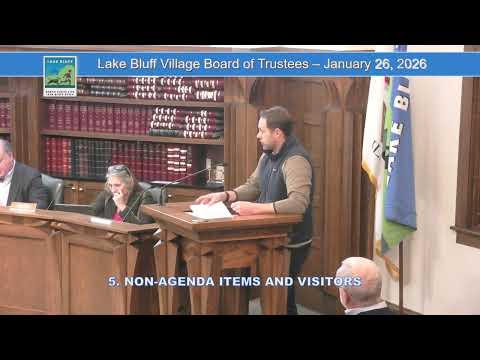
Several Lake Bluff residents used the non‑agenda public‑comment period on Jan. 26 to press the Village Board about pedestrian and driver safety at Oak Avenue and the East Scranton intersection.
Katie Riley Govan, who identified herself and gave her address, said she and neighbors have observed a “consistent flow of wrong way traffic that is occurring, along Oak Avenue,” and that the problem has worsened with nearby construction. Nick Anderson and Ron Govan also described repeated near-miss incidents; Ron Govan said he encounters wrong-way drivers “multiple times a day” while walking in the area and said drivers “did not care one bit.”
Village staff answered during and after public comment. The Village Administrator said planned streetscape improvements by the developer — including curb bump-outs at the Scranton crossing — are intended to reduce pedestrian crossing distance and exposure. Staff also said there were no immediate plans to add stop signs; they explained that formal requests for traffic control devices follow the village’s established review process and that staff will forward the residents’ materials to the appropriate review.
Residents provided photographs and drawings to illustrate sight‑line problems at the intersection, noting parked cars and the placement of the stop sign create limited visibility. Neighbors suggested short‑term remedies such as additional signage or stop signs and asked the board to consider interim measures while larger streetscape work proceeds.
The board acknowledged the concerns and said staff will follow up through the village traffic‑control procedures and keep the residents informed of next steps.
Next procedural steps were not set as formal direction in the meeting record; staff indicated they would be in touch with the residents.