Get Full Government Meeting Transcripts, Videos, & Alerts Forever!
Get email alerts on the Snow Removal Hoa Policy topic
No spam. Unsubscribe anytime.
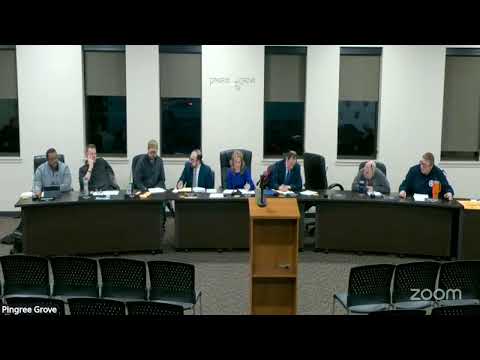
Pingree Grove board debates requiring HOAs to clear snow within 8 hours after 2 inches; staff to revise ordinance
Summary
Trustees discussed a draft ordinance that would require homeowners associations to clear sidewalks/paths within eight hours of 2 inches of snow. The board debated whether to apply the rule only to non‑elected HOAs or to all HOAs, enforcement mechanisms, and how fines would be assessed; staff will revise the draft and return it for further consideration.
Trustees for the Village of Pingree Grove spent the meeting’s longest discussion on a proposed ordinance that would require homeowners associations (HOAs) to clear snow within eight hours after two inches of accumulation.
Andy (village staff) introduced the draft as a response to a pattern of resident complaints about snow removal in several neighborhoods and said the ordinance, as written, would require HOAs to “remove snow…within 8 hours of snow accumulation of 2 inches or more.” He said the draft initially targets HOAs that do not have an elected board, on the view that elected HOA boards offer an internal accountability mechanism.
Trustees raised several practical and legal concerns. Some argued the rule should apply to all HOAs so that the village could enforce consistent standards in communities that have persistent problems, including Cambridge Lakes North, Fairview Heights and Sunset Cove, which trustees named as recurring trouble spots. Others warned that applying the ordinance broadly could raise contract costs for HOAs and that enforcement could be difficult when the responsible party is a management company or a developer.
Michael (village attorney) advised the board that the most practical legal target may be the owner of record for the common area (the HOA entity) rather than private contractors, because ownership is objective and verifiable. He also explained the administrative enforcement pathway: local ordinance adjudication hearings, escalation if fines are not paid (administrative timelines were described as 11 days, then 21 days, with potential referral to collections thereafter), and the option to require an appearance before an adjudication hearing officer.
A contractor with experience in HOA snow contracts told trustees that many contractors are already fully scheduled for winters and that forcing stricter liquidated‑damages terms can materially raise bid prices. Trustees discussed whether fines should be assessed to management companies, the association, or pursued against developers in specific problem cases. A proposed minimum penalty of $75 was mentioned in discussion as a starting point, but trustees noted higher fines may be needed to change behavior.
No final vote was held. Staff was directed to revise the draft ordinance to reflect the board’s input — including options for applying the rule to all HOAs, clarifying enforcement and notice procedures, and refining how fines and collections would be handled — and to return the ordinance for further consideration at a future meeting.
The board adjourned to executive session after the discussion.