
Santa Ana council approves police drone program in close 4–3 vote after hours of public debate
Get AI-powered insights, summaries, and transcripts
Subscribe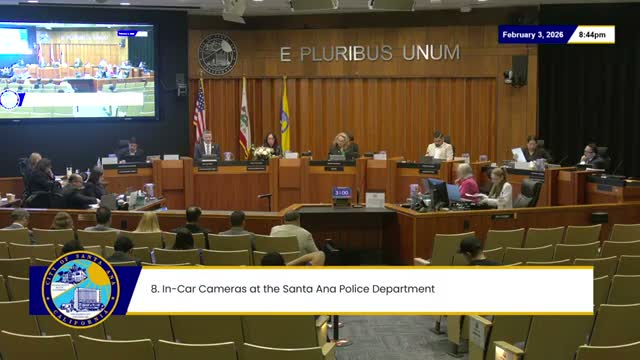
Summary
After hours of testimony and a split council debate, Santa Ana approved a contract to buy docked Skydio X10 drones and smaller deployable drones for first‑responder use; the vote was 4–3 and council members stressed safeguards, oversight and public‑records limits.
Santa Ana’s City Council voted 4–3 on Feb. 3 to approve a contract with Axon Enterprise, Inc. for the purchase and deployment of unmanned aerial systems (UAS) to be used as first‑responder tools by the Santa Ana Police Department.
The approved package calls for three docked Skydio X10 drones with docking stations placed on city buildings and two smaller Skydio R10/Arc units for patrol and special‑weapons operations. Police staff said the system is intended to speed response times, provide situational awareness and reduce reliance on costly helicopter contracts. Mayor Pro Tem Penalosa moved the agreement; Mayor Mesquita seconded it. The motion carried with Councilmembers Becerra, Pham, Penalosa and Mesquita voting yes and Councilmembers Hernandez, Lopez and Vasquez voting no.
The council meeting followed nearly three hours of public comment in which residents and advocacy groups split sharply. Supporters described drones as a rapid‑response tool that can reach scenes in minutes, help locate missing people and reduce risk to officers. Opponents warned of surveillance creep, potential sharing of data with federal agencies, and the fiscal cost of building a long‑term surveillance infrastructure. “This will erode our privacy, encourage racial profiling via AI,” said a Zoom speaker during public comment.
Police Chief Robert Rodriguez and staff presented the program as limited to defined incident types — crimes in progress, missing or at‑risk persons, search‑and‑rescue and large incidents — and said the drones would not use facial recognition, would not continuously record the public and would be governed by a draft policy and public audit logs. “The city or the department owns 100% of the data,” Rodriguez told council members, and staff said retention would be limited to footage with evidentiary value and processed like body‑worn camera records.
Councilmembers pressed staff on vendor selection and oversight. Several members urged referral of the policy draft to the Police Oversight Commission; Councilmembers Hernandez and Vasquez offered a sub‑motion to remit the item to that commission, which failed 2–5. Chief Rodriguez said the department would seek FAA beyond‑visual‑line‑of‑sight waivers and that full policy implementation and pilot training would be required before operational deployment.
The approved purchase was presented as a mix of docked first‑responder systems and smaller handheld drones intended for confined‑space or indoor situational awareness; staff said emergency‑use examples included incidents where drones arrived before officers and helped resolve barricaded‑suspect events. Opponents urged stronger limitations, more precise retention and deletion language, and an independent public reporting requirement. The city attorney said drone data remains subject to SB 54 (California Values Act) and that requests for footage would be evaluated and redacted as required.
Next steps in the project include procurement, siting of docking stations on city‑owned buildings, selection and training of pilots and application for FAA waivers. Council members who voted for the program said they expect the policy and implementation details to return for annual oversight and as part of future policy reviews.