
Glendale warns emergency housing voucher funding will likely run out in months; 188 households affected
Get AI-powered insights, summaries, and transcripts
Subscribe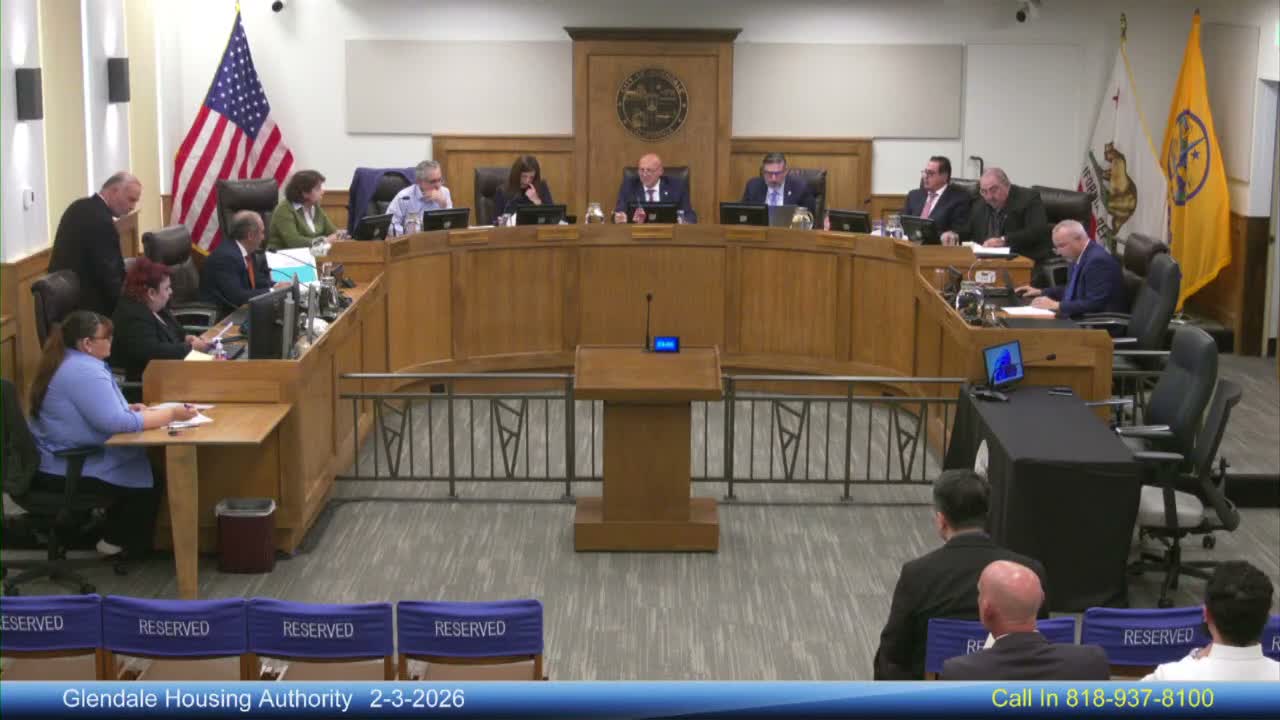
Summary
City staff told the Glendale Housing Authority that federal emergency housing voucher (EHV) funds, which support 188 current households, are projected to be exhausted in about seven months absent new federal appropriations; staff recommended not absorbing the vouchers into the regular Housing Choice Voucher program and will return with options after reviewing the new federal budget.
Glendale Housing Authority staff told the board on Feb. 3 that federal emergency housing voucher funding that supports 188 households in Glendale is likely to be exhausted in roughly seven months unless Congress provides additional appropriations. Irene Kasabian, housing supervisor for the housing division, said Glendale originally received 225 EHVs under the American Rescue Plan Act and currently has 188 leased.
"The emergency housing voucher program was established in 2021 under the American Rescue Plan Act," Kasabian said, explaining the program was created to help households experiencing homelessness, at risk of homelessness, recently homeless people and survivors of domestic violence. She told the authority that rapid lease-up nationwide and rising rents increased per-voucher subsidy costs and have accelerated depletion of the program’s funding.
Kasabian gave a financial estimate during questions: the direct owner payments for 188 households total about $350,000 per month — roughly $4.2 million a year — not including administrative fees or operating costs. She said letters were mailed to EHV tenants and owners on Jan. 5, 2026, notifying them of the funding outlook.
Staff cautioned against absorbing EHV households into Glendale’s Housing Choice Voucher (HCV) program or placing them at the front of the closed HCV waiting list. Kasabian said HUD rules do not require agencies to convert or absorb EHVs, and Glendale’s HCV program is under budgeting constraints that would jeopardize assistance to current participants if the city absorbed additional households. The authority’s waiting list has been closed since 2001 and staff noted roughly 1,000 families remain on it.
"We could [place EHV households on the HCV waiting list], but we don't recommend it," Kasabian said, citing fairness for long-standing applicants and current funding shortfalls. City staff added they had no concrete alternatives to present at the meeting but would review a federal budget that passed earlier the same day and pursue advocacy and other options.
Commissioners discussed local short-term bridging ideas, including Measure A funds. One commissioner noted Measure A was roughly a $2.5 million allocation citywide but staff said the net amount available to use could be closer to $1 million, and that Measure A cannot be used for permanent housing; staff warned those funds would provide only a short-term bridge for direct EHV payments.
Public commenters included Beth Brooks, who criticized what she called the program’s relative generosity for some recipients and urged broader distribution of assistance, and Carmen Kalouse, an EHV participant who described the voucher as a lifesaving benefit and asked the authority not to cut the program. "It's been a blessing. It's been a lot of help in my life," Kalouse said.
Fernando Aldon, a community speaker, urged the city to work with landlords, businesses and community partners to find solutions. Council members and staff asked that options and potential advocacy steps be returned to the housing authority by the end of the month.
No formal policy change or motion on EHV absorption was taken at the meeting; the authority approved procedural minutes and adjourned. Staff said they will continue advocacy with regional partners and examine the recently passed federal budget for HUD funding that could alter the local outlook.