
House subcommittee hears witnesses on elder abandonment, data gaps and implementation of Law 100
Get AI-powered insights, summaries, and transcripts
Subscribe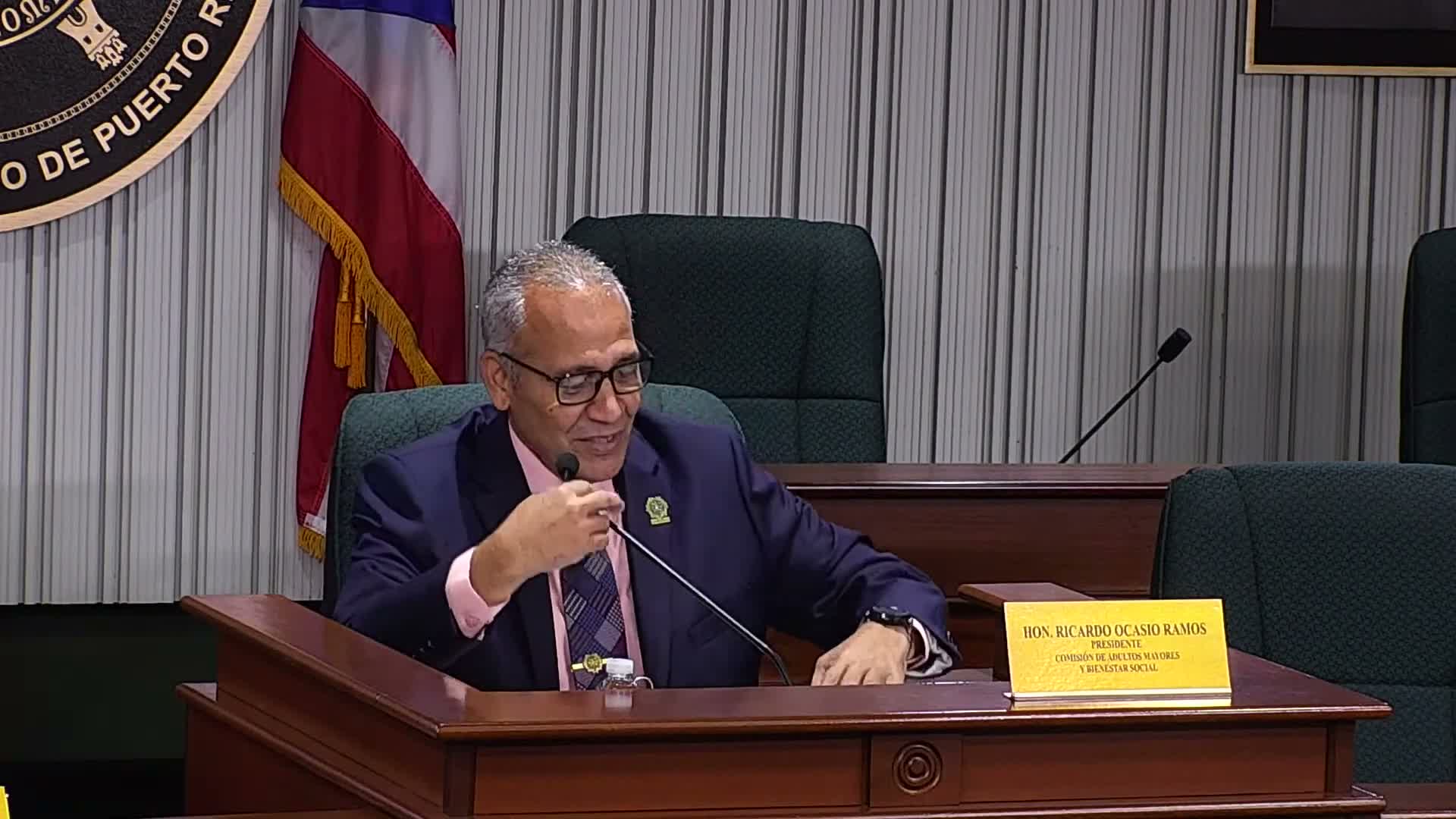
Summary
A House subcommittee heard testimony from the Department of the Family, the Office of the Procurador for Older Adults, the Puerto Rico Police and community groups about growing cases of elder abandonment, inconsistent agency data, recent legal amendments and the need for interagency coordination and preventive community programs.
Representative Ricardo Chino Reyes Ocasio Ramos, chair of the House subcommittee on Older Adults and Social Welfare, opened a public hearing to consider Resolutions 276, 329 and 372 aimed at investigating implementation and compliance with Law 100, the charter of rights and public policy for older adults, and the problem of abandonment.
Nicole Báez Ortiz, representing the Department of the Family, told the subcommittee that the department provides protection and support services for older adults and adults with disabilities and that its protection program currently serves "1,555 adults mayores y adultos con impedimentos" and that "6225 adultos mayores y adultos con impedimento [están] subvencionados" across programs. She described interagency protocols with hospitals, an external provider assigned to expedite hospital referrals, and training for hospital case managers. Báez said the department has published protocols and guidance on its website and has submitted explanatory memorials to the Legislature and governor’s office.
Francis Vidal Rodríguez, speaking for the Office of the Procurador for Older Adults (OPEA), reviewed demographic and legal context, called Law 100 a broad and recently amended statute and highlighted the Article 24 committee created to oversee implementation. OPEA reported it received 12 complaints of abandonment in fiscal 2024–25 (four in hospitals) and six complaints for the current fiscal-year window described in its memorial (one in a hospital). Vidal emphasized the need for standardized definitions and warned that differing agency definitions and data collection methods hamper an objective assessment of the problem: "hay que definir qué tipo de abandono."
Teniente José Sánchez Marchan, police liaison for older adults, said the Puerto Rico Police lack a discrete coding category in the National Incident-Based Reporting System to identify older‑adult abandonment, which limits official statistics and interagency follow-up. He added the department completed retraining under General Order 606-45 and is developing a dashboard and an interagency protocol for handling financial‑exploitation referrals; the police reported receiving 875 referrals in 2025 (most suspected exploitation) compared with 77 in 2024, a jump police said reflects increased reporting and outreach.
José Acaron of ARP, a community organization, told the commission abandonment is a systemic problem driven by decades of under‑planning and fragmented services. He and other witnesses urged the Legislature to push agencies to coordinate, to convene the Article 24 committee more regularly and to prioritize prevention, education and community pilots rather than only short‑term subsidy increases.
Members pressed the Department of the Family on operational details. The department described the hospital referral flow: hospitals identify potential cases, refer to the department’s maltreatment line, a social‑work case manager is assigned and, when necessary, the department provides temporary custody or a subsidy while it locates family. The department agreed to provide the subcommittee with regional statistics, minutes of Article 24 committee meetings and staffing information within five days.
Witnesses and lawmakers repeatedly raised three cross‑cutting concerns: inconsistent data definitions across agencies, insufficient staffing and funding at key agencies, and the need to strengthen community‑based prevention. Panelists recommended standardizing statistical categories, reconstituting and regularly convening the committee charged by Law 100 to monitor implementation, and expanding educational campaigns and pilots that engage churches and civil‑society groups.
The hearing concluded with a request for records and a five‑day deadline for data delivery. No formal vote was taken during the session; the subcommittee is expected to use the materials it requested to inform follow‑up hearings and potential legislative fixes.