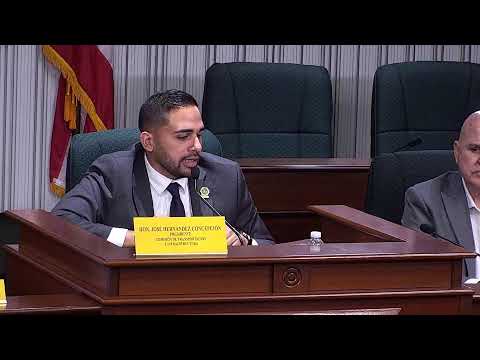
House of Representatives committee hears testimony on Proyecto de la Cámara 10-18 to regulate off‑road and low‑speed vehicles
Loading...
Summary
Committee on Transportation and Infrastructure took testimony on Proyecto de la Cámara 10-18, which would amend Ley 22 (2000) to create a digital registration, inspection and conditional 'street‑legal' authorization for ATVs and low‑speed vehicles. Agencies acknowledged safety benefits but members pressed for limits on executive rulemaking, enforcement capacity, and funding for trauma care and insurance coverage.
At a public hearing of the Puerto Rico House of Representatives Committee on Transportation and Infrastructure, officials and outside witnesses presented and questioned Proyecto de la Cámara 10-18, a measure to amend Ley 22 (2000) to establish a uniform digital registry, inspection standards and conditional "street‑legal" circulation for all‑terrain vehicles, low‑speed vehicles and similar units.
The bill’s sponsors and government witnesses said the proposal fills gaps in current practice by creating a centralized digital marbete and allowing agencies to verify registration electronically. "Se autoriza de manera condicionada la circulación street legal" and the measure sets a 25‑mph limit for low‑speed vehicles, Secretary Edwin González told the committee, adding the changes would align Puerto Rico with federal standards. José "Memo" González of the Commission for Traffic Safety said technology such as license‑plate readers (LPR) already in use could help enforcement: "las cuales pueden leer 900 tablillas por minuto." Coronel Orlando Rivera Lebrón of the Puerto Rico Police said the bill would give officers tools to identify vehicles and enforce the rules, but stressed that implementation must include mandatory identification, insurance and training.
Lawmakers pressed two overarching concerns. First, several representatives warned the bill delegates core legislative choices about where and which vehicles may circulate to the executive branch. "Esto renuncia a esa facultad que tenemos," Representative Denis Márquez said, urging that the Legislature retain authority to define which roads and hours are appropriate for certain vehicle classes. Second, members questioned whether police and municipal infrastructure have the capacity to enforce a wider, lawful circulation and whether registration incentives would simply legalize vehicles that currently operate unsafely.
Health and fiscal witnesses urged parallel safeguards. Representatives of the island’s trauma system (ASEM/SEM) supported regulation to reduce harm but warned that existing exclusions in Ley 111 (2020) shift medical costs to the public trauma center. Dr. Regino Colón Alsina asked the Legislature to include a dedicated financing mechanism — for example, a portion of marbete or tablilla revenue — to underwrite trauma care tied to any expansion of authorized circulation. The Administration of Compensations for Automobile Accidents (ACA) presented an actuarial study proposing differential premiums (about $85 for agricultural use and $125 for other ATVs) and estimated additional fiscal exposure in the range described by consultants.
Committee members sought specific data: counts of vehicles in each classification, recent crash and fatality figures, and the actuarial study underlying ACA’s projections. Agencies committed to supply statistics and the requested material within five business days and to provide draft regulatory language and cost estimates for further review. Representative 12 moved that the committee draft a joint resolution asking DTOP for a complete registry and classification; the chair deferred further action for later discussion.
The hearing left several open questions: whether the final law will embed detailed road‑by‑road limits or return regulatory specifics to the Legislature; how insurance and ACA exclusions will be amended to avoid shifting uncompensated trauma costs to public hospitals; and what enforcement resources municipalities and police will need. The committee recessed and scheduled follow‑up work and additional panels to examine fiscal, insurance and safety details.