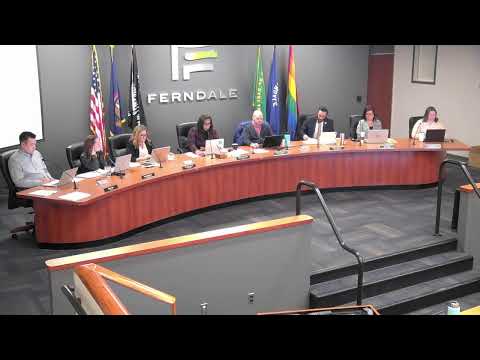
Ferndale residents press council for stronger surveillance limits as ordinance advances to second reading
Loading...
Summary
At a public hearing, dozens of Ferndale residents urged the City Council to strengthen a draft surveillance ordinance — citing data‑sharing concerns, a 30‑day retention provision and lack of enforceable penalties — and several council members said more work is needed before a final vote.
Ferndale — Dozens of residents pressed the City Council on Monday night to tighten a draft surveillance ordinance and to delay any related equipment contracts until protections are binding rather than advisory.
Residents at the public hearing repeatedly raised concerns about license‑plate readers and other technologies and asked whether the draft would block procurements before public input, who could access collected data and whether the city could enforce any limits. "A camera is a camera is a camera," said Andrea Popovich, a Ferndale resident, arguing that devices marketed as license‑plate readers still capture images of people, children and movements.
The ordinance, the City Manager said, sets a formal procedure for consideration of future public surveillance technology, requires a surveillance‑technology specification report, annual procurement and use reports and sets limits on retention, access and sharing; the City Manager also noted the public comment period is open through noon on Monday, February 9. The council adopted alternate public‑hearing rules for the night and opened the hearing so speakers had five minutes for their remarks.
Public speakers pressed the council on several technical and policy points: defining who may declare an "exigent circumstance," limiting data‑retention windows, requiring concrete civil‑rights and racial‑impact assessments before approval, instituting independent audits, and spelling out enforceable penalties for misuse. Craig Sahaki, who urged the council to reject the draft in its current form, said the proposal "reads like a permission slip with additional paperwork requirements" and called instead for stronger prohibitions or a ban on certain technologies.
Several speakers also cited Ferndale's recent experience with a vendor called Flock, saying that past contract language and vendor policy changes eroded public trust and underscored the need for enforceable contract terms that prevent outward data flows. Other commenters urged the council to require third‑party audits or community representation in oversight rather than relying solely on internal reviews.
Council members replied that the draft draws extensively on model language used in Detroit and that the 30‑day retention period reflected a common investigatory practice recommended at the state level; at the same time, multiple council members said the 30‑day period and other provisions should be revisited. One council member who helped draft the ordinance said collective‑bargaining rules limit the city’s ability to prescribe certain personnel penalties by ordinance, but counseled that progressive discipline and contract negotiations are available avenues for enforcement.
Council members and the City Manager said there is appetite to tighten definitions of exigent circumstance, add clearer documentation and reporting requirements (including potentially more frequent use reports), and explore mechanisms for stronger oversight and penalties while remaining mindful of legal and labor constraints. Several council members said the volume and substance of public comments made it clear the draft needs more work; the council closed public comment at 8:01 p.m. and moved to further internal discussion.
Next steps: the City Council signaled it will continue revising the draft and scheduled a second reading of a revised ordinance for February 9; the public comment period remains open through noon that day.
(Reporting based on a Ferndale City Council public hearing and public‑comment period.)