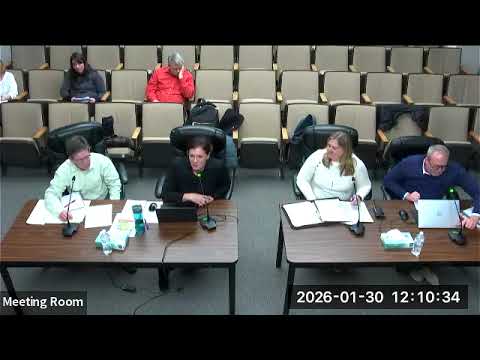
Cheyenne council reviews conceptual plans and timeline for municipal building renovation
Loading...
Summary
City designers and public-works staff presented a conceptual renovation to Cheyenne’s municipal building and a new council chamber, citing decades-old systems, ADA gaps and security needs; acquisition of an adjacent council building hinges on a HUD review and the project’s schedule remains contingent on that process.
Cheyenne officials presented conceptual plans on Jan. 30 for a major renovation of the municipal building and a new council chamber, saying decades-old mechanical, electrical and accessibility systems no longer meet the city’s needs.
"This building was built almost 50 years ago, and it has had no major renovations," said Vicky Nemechek, director of public works, listing inconsistent HVAC performance, an elevator that has been inoperable because replacement parts are no longer produced, electrical capacity limitations and plumbing coupler failures as drivers for a full renovation.
Design teams led by Britt Morgan, vice president of Plan 1 Architects and the firm’s Cheyenne office lead, and Krista Plaza, president of Vicenza Architecture, walked the council through site plans, floor-by-floor layouts and an overall schedule. Morgan said the team validated a prior spatial analysis with employee surveys and department-head meetings and will produce a conceptual cost estimate in February that includes soft costs omitted from earlier work.
Why it matters: Council members pressed on accessibility, public access and cost risk. Officials said the building currently fails several modern ADA standards — ramps and restrooms are not fully accessible, elevators are too small to accommodate stretchers and the dais is not easily approachable — and that a renovation offers an opportunity to bring meeting rooms and public-facing services to the first floor. Designers emphasized balancing public access with a more secure entry system.
Key timeline and procurement details: The design team presented two linked schedules for the municipal building and a separate council chamber renovation, saying schematic design is expected around March 2027 and that council-building construction could begin in late summer 2027 if approvals proceed as planned. A scheduling note on procurement was corrected during the meeting: staff said the CMAR (construction-manager-at-risk) advertisement date for both projects should be Feb. 25, 2026.
Acquisition dependency: Amber Ash, the city’s chief of staff, told the council the city has sent a formal offer or letter of intent for the adjacent property intended for the new council chamber and that any acquisition will require HUD review. "The HUD process will take some time," Ash said, adding that the city does not control HUD’s schedule and is coordinating with CHA and HUD staff.
Accessibility, security and chamber design: On the council chamber, designers proposed reorienting the chamber to use existing structure, adding fixed seating for about 80 people, an operable partition for expandable committee space, and two public entries. Council members debated fixed versus flexible seating and asked designers to ensure audiovisual systems and sightlines allow clear viewing for the public. In response to a council question about recent legislation permitting concealed carry in public buildings, the design team said security features are being requested and noted a hidden door behind the dais to allow quick egress.
Technical and structural checks: When asked about structural concerns related to adding windows, the team said windows can be added but typically require reinforcing lintels and additional steel supports. The team also reported active geotechnical work: their geotechnical engineer found fines and noted historic settling that may date to an earlier flood; structural engineers are testing whether the settling is ongoing and budget allowances will be included if repairs are required.
Public engagement and next steps: Designers said they have not yet held public forums and welcomed the idea of community meetings. They ran a brief interior-visioning exercise at the session and asked council members to submit further feedback within a two- to three-week window so the team can refine plans.
What was not decided: Council members did not vote on any measure and no contract or budget was approved; cost totals, final scope and permitting contingencies remain "not specified" pending schematic design, geotechnical findings and HUD timelines.
The council agreed to receive updated materials and consider an informal follow-up in the coming weeks; the chair adjourned the session without taking action.