
Special‑education share of district rolls rises above federal cap; Granville adds academic coach
Get AI-powered insights, summaries, and transcripts
Subscribe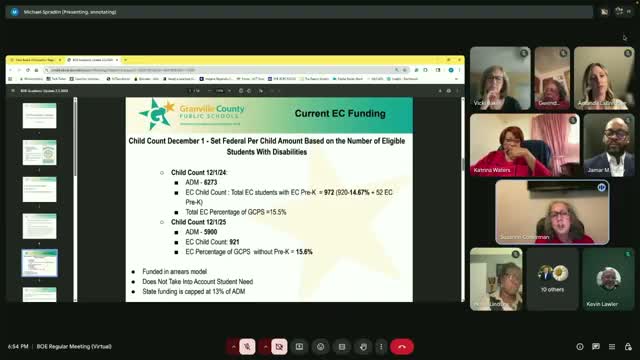
Summary
Granville County’s Exceptional Children program reported that students with disabilities now account for about 15.6% of enrollment (above the federal 13% funding cap). The district repurposed an existing position to create an EC academic coach and emphasized audits, compliance, and staffing needs.
At the Feb. 3 meeting the Granville County Board of Education received an update on special education services and funding from Dr. Cotterman, director of the Exceptional Children (EC) program.
Dr. Cotterman said the district’s December 1 child count in 2024 recorded an average daily membership of 6,273 students with 972 students identified for EC services (about 15.5%). The department’s current figures show ADM around 5,900 with 921 EC students, placing the EC share at approximately 15.6% without preschool, above the federal funding cap of 13 percent. “Anything over 13% we are funding out of other areas, state, local funds,” Dr. Cotterman said, explaining how the cap leaves districts to cover excess costs for specialized services.
Dr. Cotterman described constraints in the current flat funding model — approximately $5,000 per EC student under the formula — and said the state’s move to a single annual child count makes funding effectively one year in arrears. She noted the legislature has discussed a weighted funding pilot that would allocate funds by student need but said that effort is stalled.
To bolster instruction and close gaps, the district repurposed an existing position to create an EC academic coach who will support special education and general education teachers and help align interventions with the district’s strategic plan. Dr. Cotterman also described compliance work: a recent district audit and targeted desk audits, file reviews and professional development to improve IEP quality and service delivery.
Board members asked about staffing and substitutes in EC classrooms; HR and EC staff said principals and compliance specialists aim to place qualified substitutes or use experienced teaching assistants where possible and that long‑term subs receive targeted support and training. Dr. Cotterman confirmed the department continues to recruit staff and currently estimates six to seven open positions in EC that remain a hiring priority.
The board thanked Dr. Cotterman and staff; Dr. Cotterman also announced she will retire at the end of the school year and staff said they will pursue overlap hiring so knowledge is transferred before she departs.