Get Full Government Meeting Transcripts, Videos, & Alerts Forever!
Get email alerts on the Pfas Treatment topic
No spam. Unsubscribe anytime.
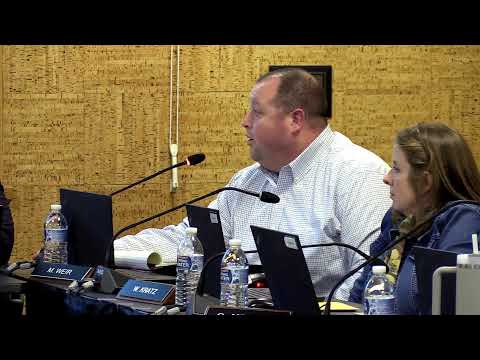
Boyertown Area SD to pursue local PFAS treatment at Gilbertsville Elementary; vendor estimates 10‑year media life
Summary
District facilities staff and Suburban Water Technology briefed the board on PFAS/PFOA treatment options for Gilbertsville Elementary, favoring ion‑exchange resin over activated carbon and asking Suburban for a formal proposal and cost breakdown to bring back next week.
Board Chair and facilities staff said they will seek a formal proposal to install a local filtration system to reduce PFAS and PFOA at Gilbertsville Elementary after a presentation from Suburban Water Technology.
Suburban’s representative told the board that Resintech modeled the school’s water chemistry and estimated the ion‑exchange media "should last us around 10 years," and that, when annualized, the maintenance cost would be roughly $1,000 per year. The vendor recommended resin over activated carbon because resin requires less contact time (about five minutes versus about 20 for carbon), smaller vessels and less frequent media replacement.
The recommendation prompted questions from board members about operational experience, taste and interim safety measures. A board member asked whether the district had used resin at other facilities; Suburban said it had not personally operated all installations but had consulted DEP engineers and others who reported successful deployments elsewhere.
On interim measures, Suburban and facilities staff said current results are "well below the thresholds" that trigger an immediate emergency response under DEP rules, and that continuing to use the water while accelerating treatment is a reasonable option. The vendor identified two contingency steps if future samples spike: request an emergency permit from the Pennsylvania DEP to expedite installation or deploy bottled water temporarily.
Facilities leadership asked Suburban to submit a formal written proposal breaking out professional‑engineering fees separately from equipment and installation so engineering services (which do not require formal public bidding) can be approved independently. The board chair asked for that proposal to be returned by next week; Suburban agreed to prioritize the request.
The vendor also discussed short‑term hardware options, including point‑of‑use filter housings for drinking fountains and retrofit filters for bottle‑fill stations, that could be installed for a few hundred dollars per fountain as temporary mitigation while larger systems are permitted and installed.
Testing and monitoring details were discussed: PFAS/PFOA sampling is performed quarterly and compliance is determined by a running annual average. Other parameters are tested on varying cycles required by Pennsylvania DEP (for example, monthly coliform checks and multi‑year cycles for lead/copper and radiologicals). The vendor said it performs weekly on‑site checks for disinfectant residuals and maintains a master compliance calendar for all systems it operates.
Next steps: the board asked staff to return a formal cost and timeline proposal from Suburban Water Technology at the board’s meeting next week. The district said available capital project funds would be used to repay the expenditure if the board approves moving forward.