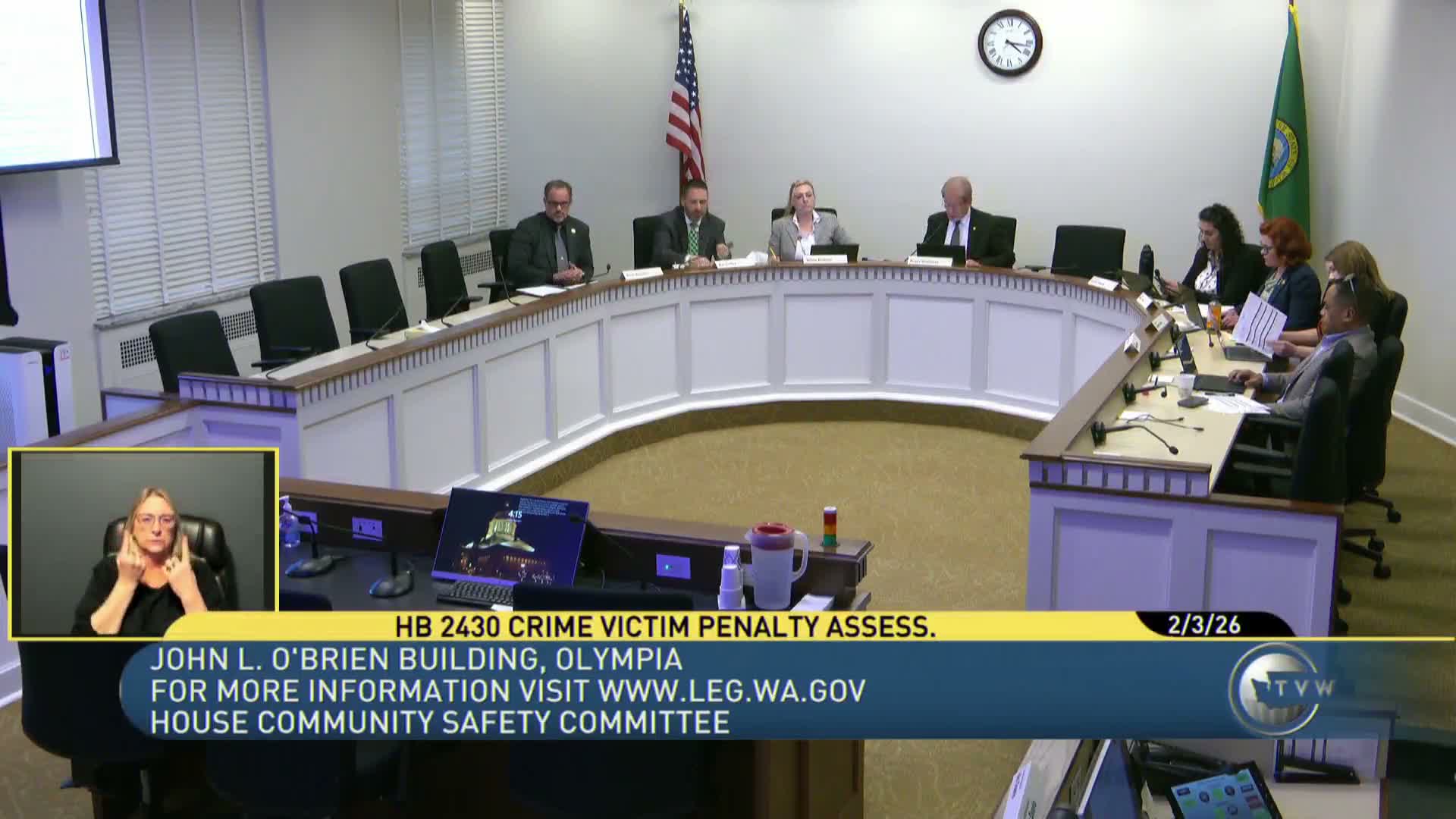
House committee advances bill that narrows prostitution penalties, boosts buyer penalties and directs fees to survivor services
Loading...
Summary
The House Community Safety Committee advanced substitute HB 2526 on Feb. 3, 2026, adopting an amendment that directs referrals to services for first and second investigative detentions and raises penalties for buyers; the committee reported the substitute out on a 5–4 vote.
The House Community Safety Committee on Feb. 3 advanced a substitute to House Bill 2526 that renames and restructures the law governing prostitution, prioritizes referrals to services for people engaged in sex work on first and second investigative detentions, and increases penalties for repeat purchaser offenses.
Supporters including the bill proponent and a member with lived experience said the substitute, H3308.1, strikes a balance between holding buyers accountable and reducing criminalization of people who are trafficked or exploited. The sponsor described the change as renaming the offense to “patronizing a person for prostitution,” classifying first and second convictions as gross misdemeanors and third or subsequent convictions as class C felonies, directing 98% of assessed-fee revenue to community-based survivor-led organizations, and adding an emergency clause with an effective date of April 1, 2026.
"If we're going to increase penalties on people who are purchasing human bodies, we must also provide pathways to services for survivors," said the proponent during floor debate, urging adoption of an amendment that would require referral to services for first and second investigative detentions.
Opponents argued the substitute in practice amounts to decriminalization of prostitution without the robust, new funding and service expansion that proponents say is required for a successful Nordic-style model. Representative Davis cited Rhode Island as a cautionary example and warned that without expanded services and enforcement capacity the policy could create enforcement and public-safety gaps. "This bill contains no expansion of services of any kind, and not one cent of additional funding," Davis said.
Other critics said the referral requirement could be infeasible in many parts of the state where specialized survivor services are scarce; Representative Griffey noted that programs are concentrated in some urban areas and may not exist in many jurisdictions.
Supporters replied that the substitute directs nearly all assessed fees to survivor-led organizations and includes protections for trafficked individuals, saying the approach will help survivors come forward and allow law enforcement to focus on purchasers and traffickers. A legislator with lived experience said the amendment gives survivors a chance to avoid criminalization and access services.
On final action the committee reported the substitute out with a due-pass recommendation on a 5–4 roll call. The votes recorded in committee were: Goodman (aye), Simmons (aye), Farivar (aye), Fosse (aye), Obras (aye); Graham (nay), Griffey (nay), Burnett (nay), Davis (nay). The committee also deferred House Bill 2641 earlier in the agenda.
The substitute now moves to the next steps in the legislative process; committee records show it was reported out for further action by the full House.
Provenance: Committee consideration, summary and debate are recorded beginning with staff summary of the substitute (SEG 207–SEG 327), the extended floor debate and amendment discussion (SEG 821–SEG 1286), and the roll-call vote and tally (SEG 1253–SEG 1286).