Get Full Government Meeting Transcripts, Videos, & Alerts Forever!
Get email alerts on the Student Consumer Protection topic
No spam. Unsubscribe anytime.
Committee reports student consumer‑protection bill with exemptions; members debate scope
Summary
The committee advanced substitute House Bill 2474 to expand uses of the Tuition Recovery Trust Fund and require teach‑out standards for closed programs, but adopted an exemption (Ren 76) for certain long‑standing private colleges and tribal institutions after debate over scope and protections.
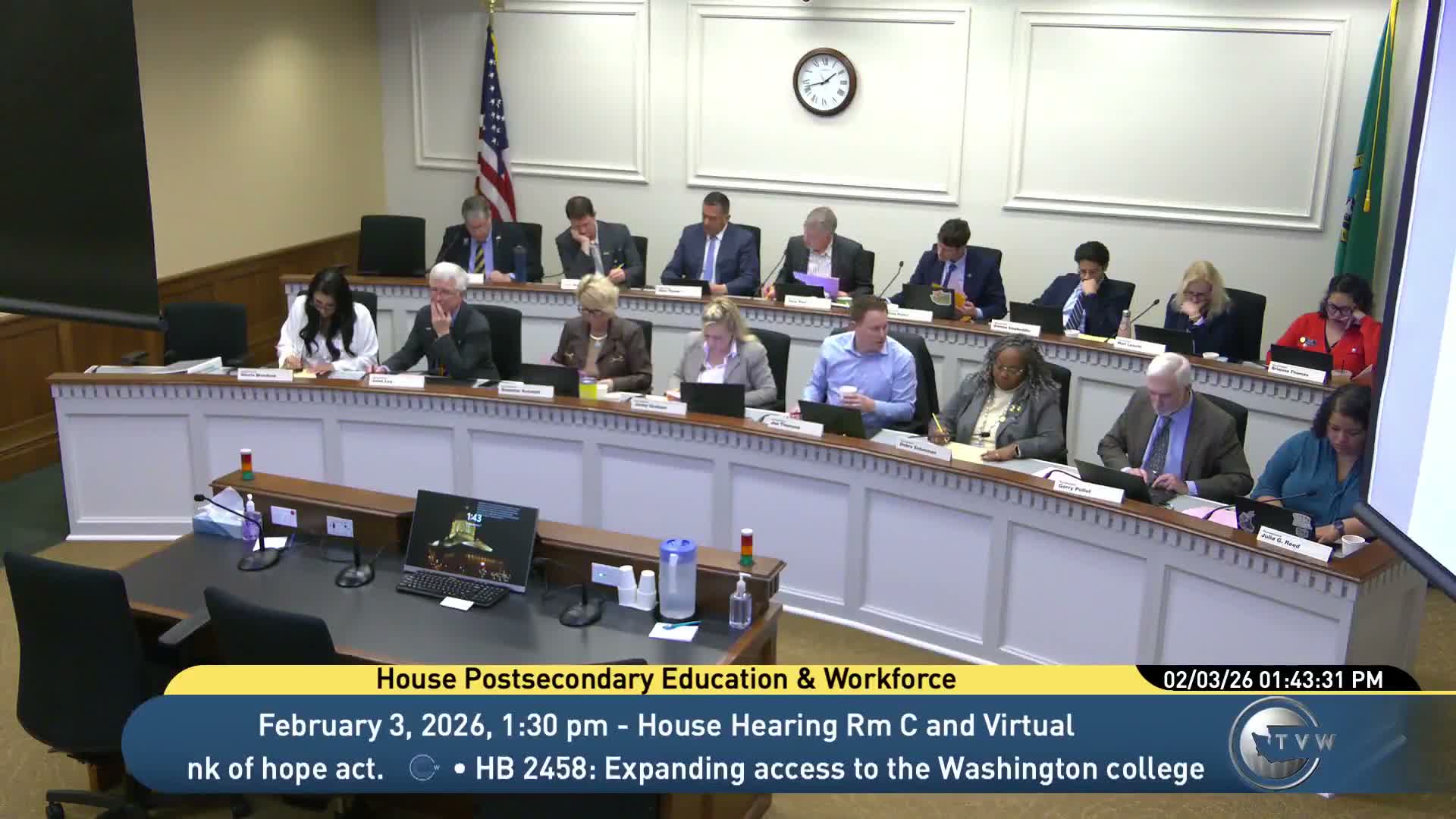
The Postsecondary Education and Workforce Committee on Feb. 3 reported substitute House Bill 2474 out of committee with a due‑pass recommendation after contentious debate over institutional exemptions and the scope of student consumer protections.
Presenter Ms. Wren summarized the substitute, explaining the Tuition Recovery Trust Fund dollars could be used for student consumer‑protection violations and that the Washington Student Achievement Council (WSAC) would be required to set standards for teach‑out arrangements that preserve material program conditions such as delivery method, pedagogy and class size.
Several amendments were considered. Rep. Ibarra announced withdrawal of three earlier amendments, and Rep. Pollet moved adoption of Ren 76, which exempts private institutions that existed on or before 1910 and institutions located on tribal reservations operated by federally recognized tribal governments. Pollet said the amendment had been worked on with independent colleges and WSAC "to try to make sure that we are not exempting other institutions that may be of concern in regard to student consumer protection needs." Rep. Paulette, a sponsor, emphasized the need for strong protections so students are able to finish programs under the same material conditions they were advertised.
Opponents raised concerns about financial and operational flexibility for institutions; Rep. Schmidt said the side would vote no, arguing the bill's guardrails do not provide sufficient flexibility for institutions to change program delivery when needed. After roll‑call the clerk announced 9 ayes and 8 nays; by that vote the proposed substitute was reported out of committee with a due‑pass recommendation.
The substitute directs WSAC to establish rules determining tuition and fee reimbursement timing and amounts and expands Tuition Recovery Trust Fund uses; the transcript records debates over institution definitions and the scope of consumer protections rather than a final administrative design.