Senate Human Services advances package of bills on juvenile reviews, child welfare and detention oversight
Loading...
Summary
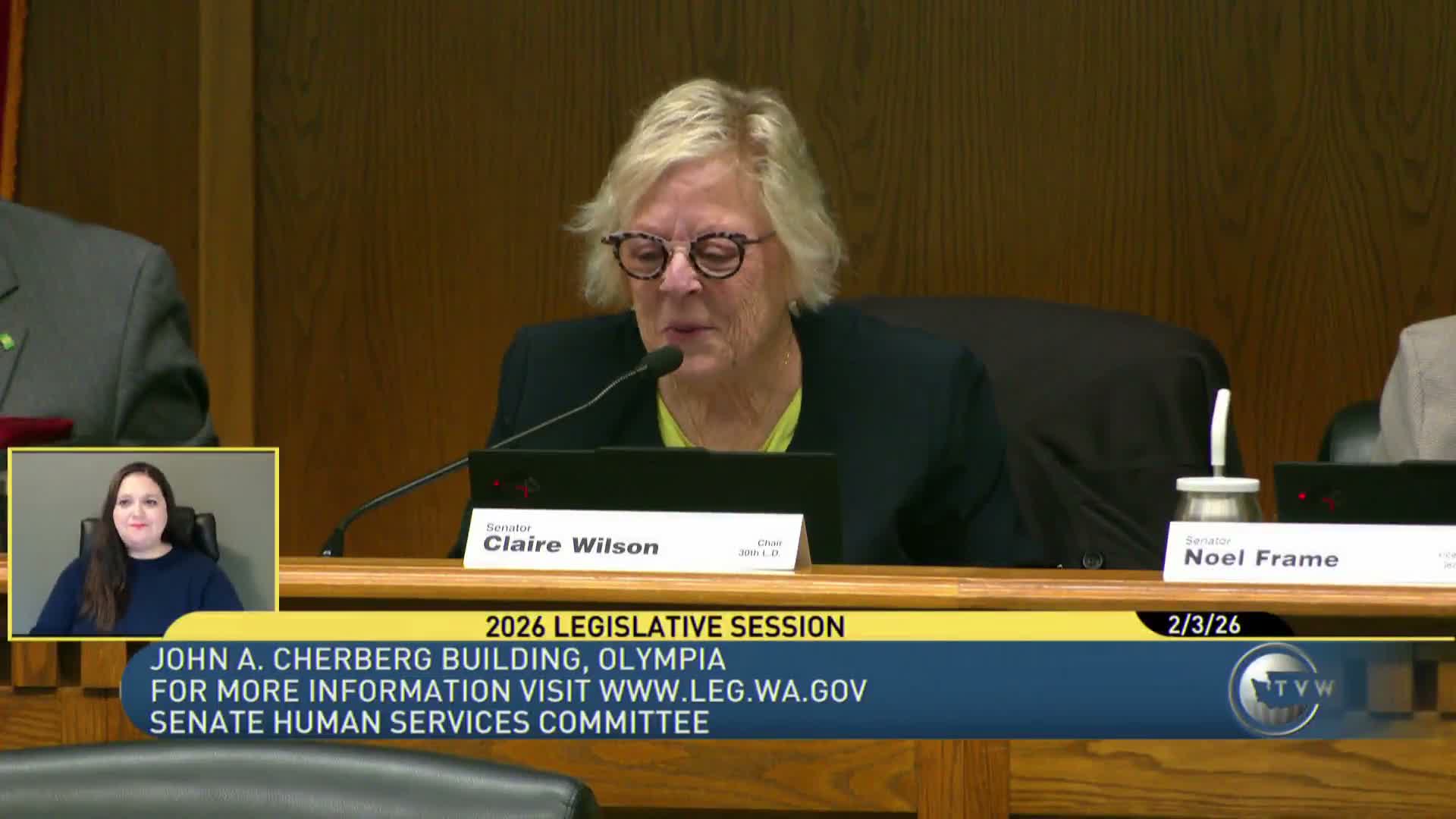
At a Feb. 3 meeting, the Washington Senate Human Services Committee heard a confirmation for DSHS Secretary-designee Angela Ramirez and advanced six bills involving juvenile midpoint reviews, child-welfare shelter-care rules, opioid-related family referrals, private detention inspections and local jail contracting to follow-up committees.
Angela Ramirez, the governor's nominee to lead the Department of Social and Health Services, appeared before the Senate Human Services Committee for a confirmation hearing and outlined priorities for the agency before the panel moved into an executive session to consider a six-bill package.
"My name for the record is Angela Ramirez," Ramirez said, describing her background and pledging legislative collaboration and operational priorities including improved electronic health records and workforce recruitment. The Lieutenant Governor spoke in the hearing chamber and "recommended her to you in the highest manner possible and without reservation," according to his remarks.
After the confirmation portion, the committee briefed and voted on the first packet of bills. The committee advanced six measures by voice vote or roll-call action and referred them to the next appropriate committee for further consideration: SB 6062, SB 6308, SB 6319, SB 6286, SB 6080 and SB 6184. Several amendments were offered and debated; most were defeated, and a handful of technical changes were adopted.
Votes at a glance: - Senate Bill 6062 (sponsor: Sen. Wilson) — proposed substitute A adopted; the bill revises juvenile disposition rules to require courts to grant a suspended disposition alternative unless remaining on community supervision would insufficiently protect the community, mandates a midpoint review in JR facilities after six months, revises the definition of rated bed capacity, and adjusts transfer authorities between DCYF and DOC. The committee passed the proposed substitute and sent it to Ways and Means (passed, "subject to signatures"). Fiscal note: DCYF estimated roughly $417,000 in implementation costs for monitoring and IT support.
- Senate Bill 6308 (sponsor: Sen. Wilson) — addresses shelter-care orders for children under five and includes amendments clarifying tribal law interaction; the committee adopted an amendment clarifying the bill does not supersede the Washington Indian Child Welfare Act and sent the substitute to Ways and Means.
- Senate Bill 6319 (sponsor: Sen. Wilson) — directs DCYF to develop community-based referral pathways for families with children under 4 when parental use of high-potency synthetic opioids is a factor, requires a referral initiation within seven days of a moderate/high risk assessment and a report to the Legislature by Nov. 1, 2027. The committee adopted a technical amendment clarifying seven-day referral timing and sent the substitute to Ways and Means.
- Senate Bill 6286 (sponsor: Sen. Orwell) — would authorize the Department of Health to issue fines for private detention facilities that deny inspection and create an Enforcement, Accountability and Community Repair account for potential assistance to individuals or families; the proposed substitute was adopted and the bill was referred to Ways and Means. A preliminary fiscal note for inspection teams was approximately $581,000 this biennium.
- Senate Bill 6080 (sponsor: Sen. Cleveland, substitute by Sen. Wilson) — addresses whether a jail may accept persons in federal custody and sets a 180-day window for jails to enter into contracts with the federal government, among other contract and transparency provisions. The proposed substitute was adopted and the bill was sent to Rules. Committee debate highlighted questions about what happens after the 180-day period and who exercises "sole discretion" at a jail.
- Senate Bill 6184 (sponsor: Sen. Wilson) — technical and statutory updates, including moving the Office of Homeless Youth to DCYF and definition adjustments; the committee advanced the bill and noted a one-time fiscal cost of $4,000.
Key committee exchanges and context: - Senator Christian repeatedly objected to several provisions across bills, arguing in multiple debates that measures would reduce community safety or insufficiently prioritize victims; in committee remarks he said, "children are dying in our state," urging more aggressive removal or staffing requirements in child-welfare legislation. Sponsors and staff countered that substitutes reflect stakeholder engagement and that implementation details, including staffing needs, are captured in agency fiscal notes.
- On juvenile-capacity questions Staff said the substitute for SB 6062 sets rated bed capacity references at 100% (the substitute reduced a prior 105% threshold) but could not provide an exact bed count for specific facilities on the record.
- On SB 6286, sponsors and opponents debated inspection frequency, the size of fines and whether state law overreaches into federally regulated contracts; proponents cited complaints and deaths as justification for stronger inspection authority, while opponents warned of federal preemption and litigation risk.
What happens next: Each bill advanced by the committee will proceed to the committee identified in the vote (Ways and Means or Rules) for further consideration. The committee scheduled additional executive-session work for the following day, including further votes and a gubernatorial appointment scheduled for executive session.
The hearing record contains direct exchanges, sponsor explanations and amendment votes for each contested measure; the committee adjourned at approximately 3:30 p.m.