
Queen Anne's County Public Schools present $13.4 million FY27 budget gap as state aid remains uncertain
Get AI-powered insights, summaries, and transcripts
Subscribe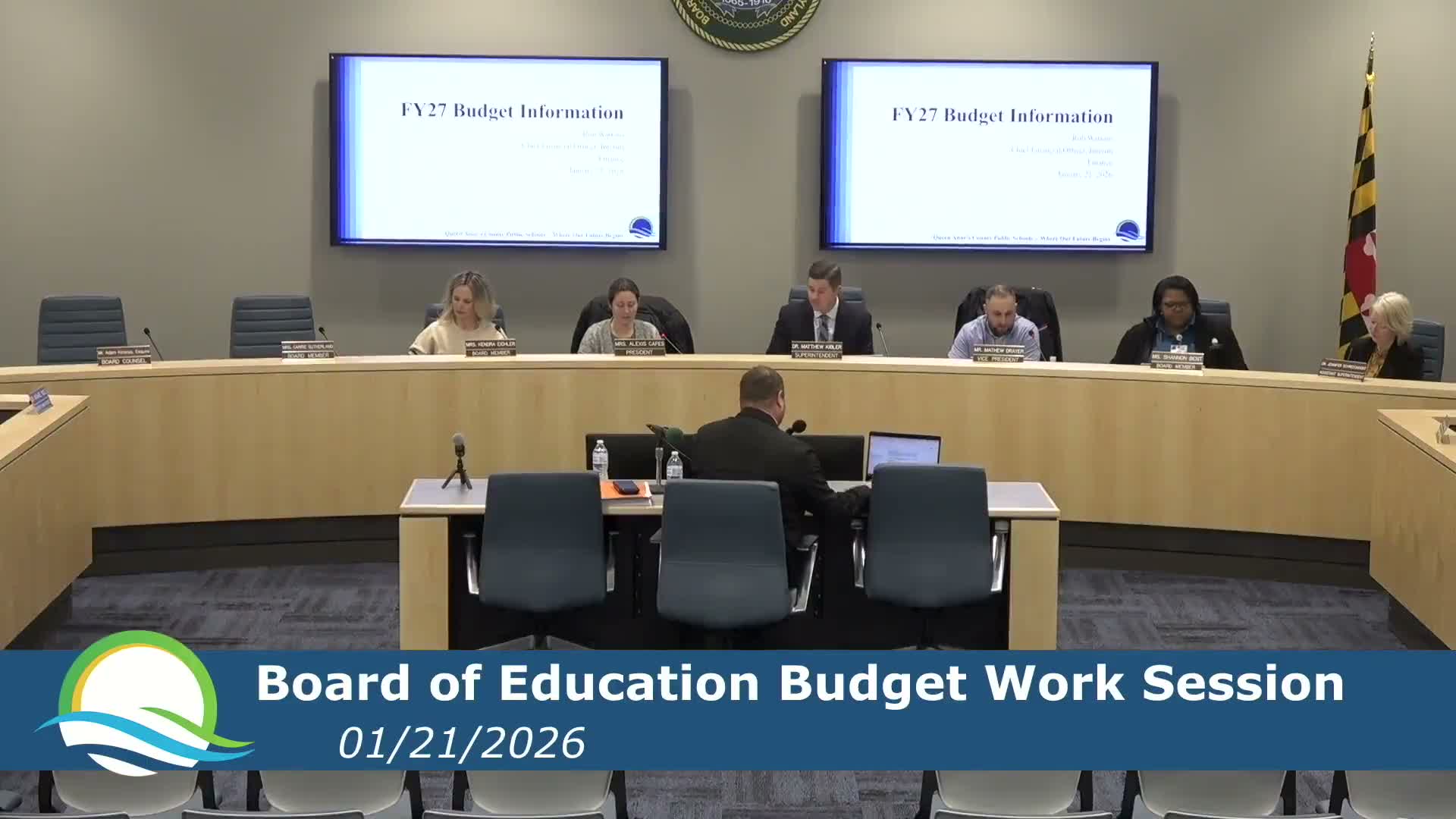
Summary
District staff told the board on Jan. 21 that the preliminary FY27 proposal would raise costs by 10.53% ($13.43 million), including $9.36 million to maintain current services and roughly $4 million for program restorations, while the Maryland state aid file needed to finalize revenues has not yet been published.
Queen Anne's County Public Schools officials told the school board on Jan. 21 that the district is preparing a preliminary fiscal year 2027 budget that would increase spending by about 10.53%, or roughly $13,434,000, but that final revenue numbers depend on a state aid file not yet released by the Maryland Department of Education.
"At this point, I'm presenting to you FY '27 budget, without the benefit of having the state aid file," Rob Watkins, interim chief financial officer, told the board. He said the district would combine the state aid file with projected expenses once it is available and produce a draft budget for approval.
The administration broke the proposed increase into two parts: $9,363,000 (about 7.35% of the current budget) to maintain the district’s existing programs and roughly $4,000,000 (about 3.19%) for program improvements and restorations. Watkins said the FY26 general unrestricted operating budget is about $127.5 million, with capital at roughly $13 million and restricted funds near $6.2 million.
Superintendent Dr. Kibler and Watkins said the district’s revenue outlook is constrained by enrollment trends and state funding formulas. Watkins reported a year‑over‑year enrollment decline of 40 students and noted that the Transitional Supplemental Instruction (TSI) program funding that supported struggling K–3 readers ended, removing about $341,000 from next year’s revenue stream.
"We do know that less students means less funding generally," Watkins said. He added that the governor released a budget but the Maryland state aid file that translates those proposals into local allocations had not been posted to the district’s files at the time of the meeting.
Officials also flagged state formula "wealth factors" that disadvantage Queen Anne’s County, citing lost access to the guaranteed tax base, comparable wage index and the blueprint transition fund. Watkins said a local share adjustment last year reduced the district’s funding by about $1.5 million.
On the cost side, the administration attributed much of the projected increase to contracted wage/fixed‑charge commitments tied to negotiated salary steps and benefits. Watkins said salary enhancements alone are projected at about $3.7 million and described increases to pension and health care costs as additional drivers.
To address program needs, Superintendent Dr. Kibler described roughly 37 positions under consideration, including six reading specialists and six math specialists (to assign one of each to every elementary school), two floating behavior specialists, a counselor at Churchill Elementary, six additional pre‑K teachers, restoration of a Spanish teacher position for middle schools, in‑school suspension supports and multilingual tutors. The administration also proposed a district grant writer and additional maintenance and HR capacity.
"The program we currently have, we need $9,300,000 more than what our budget is," Dr. Kibler said, urging the board to consider both the cost to maintain current services and a targeted 3% increase to improve student supports.
Transportation issues in the Centerville area also factored into the discussion. Dr. Kibler described a routing/tiering configuration that affects Centerville Middle, Centerville Elementary and Kennard Elementary, saying students at those schools lose an estimated 30 to 45 minutes of instruction daily and proposing shifting Centerville Middle to the high‑school tier as a possible mitigation.
Board members asked questions about the timing of the state aid file, the district’s maintenance‑of‑effort calculation (Watkins estimated the local maintenance of effort at about $82,266,000) and the potential need to ask the county commissioners for additional local funding; Watkins confirmed the district would likely request increased local support depending on final revenue figures.
Watkins said the district hopes to receive the preliminary state aid file within a week or two following the meeting and proposed placing the FY27 budget on the Feb. 4 board meeting agenda for further discussion, with an intent to approve the budget on March 4 after two more work sessions and regular meetings.
The board adjourned open session and moved into a closed session later in the meeting to discuss personnel matters under the cited statutory authority.
Next steps: district staff will combine the state aid file with the expense proposals, return to the board with updated numbers at the Feb. 4 meeting and seek formal action on a draft budget at the March 4 meeting.